
Everyone Asks If She'll Have Children. Nobody Asks Who She Married.
Why the person at your kitchen table may matter more than anyone in the boardroom
When people talk about a woman's career, someone eventually brings up children.
Will she have them? When?
How will she manage?
Nobody asks who she's married to.
Yet after twenty years of coaching senior women, and a whole book of interviews with women who out-earn their partners, I'm convinced your choice of partner shapes your career as much as whether you have kids.
I said so recently on Kelly Willis Green's Serious Coin podcast, and it's the line people have messaged me about since.
"Suzanne is marrying well"
When I got engaged, my mother took to telling people I was marrying well.
Anyone raised on Jane Austen knows what that phrase is meant to mean.
A good income. A decent estate. Possibly a horse-drawn carriage.
That isn't what she meant. In fact, my husband didn't make a particularly high salary at all back then.
What she meant was that he loved me, that he'd been there for me the whole way through my PhD.
He was kind, deeply ethical and a great cook to boot!
She still brags about the cooking.
She was asking everyone to look wider at what marrying well, and living well, actually means.
Over the years we've had the same ups and downs as the couples I interviewed.
Sometimes I've been the main earner.
Sometimes he has. Neither of us needed it to say anything about who we are.
Which, it turns out, is the whole trick.
What nearly 30 female breadwinners told me
When I was researching Female Breadwinners, the Pew Research Center had just found that 22 per cent of American wives out-earned their husbands, more than five times the figure in 1970.
In Britain, women were the main earner in a quarter of cohabiting couples where one partner earned more.
It's only become more common as time has gone on.
As Kelly points out in her recent article, Statistics Canada found that women earned more than half the couple's income in nearly a third of different-sex couples in 2023.
The women I interviewed had always expected to work.
They just hadn't expected to be the main earner. And even then, the money itself was only ever part of the story.
What made the difference wasn't the size of the gap. It was the man.
The partners who were at ease with it weren't attached to old ideas of who provides.
They were fine with one of them being up and the other down for a while, knowing it might swap again.
Where it went wrong, it rarely went spectacularly wrong.
Several women told me they'd learned to soften their good news at home.
This meant a promotion became something to mention thoughtfully, rather than hugely celebrate.
Even then, it didn't lead to arguments, but still that could be an 'ouch' moment.
Why this is a career question, not a private one
If you're reaching for a senior role, you already know the job gets heavier the higher you go.
What fewer people say out loud is that home has to carry some of that weight too.
With a great partner, you get the support you need to take the stretch role, travel for the conference, or prepare for the board while someone else makes dinner.
Without one, you'll feel minimised in your role, whether you're the main earner or not.
And that slow wearing away of yourself adds up. You can't leave it at the front door every morning and pick it up again at night.
You may already have felt this without naming it.
The role you didn't apply for because the timing "wasn't right at home".
The bonus you mentioned in passing, rather than with the glass of champagne it deserved.
If so, it may be worth reading why the promotion isn't always what you actually want and why senior women end up so exhausted.
And if you're weighing up whether you can afford to invest in yourself right now, this one is for you.
The advice I'd give my younger self
If I had to boil down everything I heard in those interviews, it would be this.
Be with a partner who's happy in their own skin.
Kelly added something I loved. Be that partner too.
My mother was right, of course. She usually is. Annoying, isn't it?
So if you're reaching for something bigger at work, it's worth asking who's cheering you on at home.
And whether you'd tell them about the next promotion the minute you heard, or wait for the right moment.
If you're weighing up a conversation like that, e-mail me at suzanne@doylemorris.com to arrange a chemistry call.
I write every fortnight about the things senior women in STEM often recognise but rarely say out loud.
Want the five steps senior women in STEM use to get promoted without burning out?
Download my free Women in Tech Promotion Playbook, and you'll get my newsletter too.
Welcome to my Blog

I'm Dr Suzanne Doyle‑Morris and I support professional women working in STEM.
Whether you’re seeking your next promotion, aiming for leadership, or simply looking to make your mark, this blog is created for you.
It's written for the ambitious woman in STEM ready to advance and succeed on her own terms.
Blog Categories
FREE GUIDE
The Women in Tech Promotion Playbook
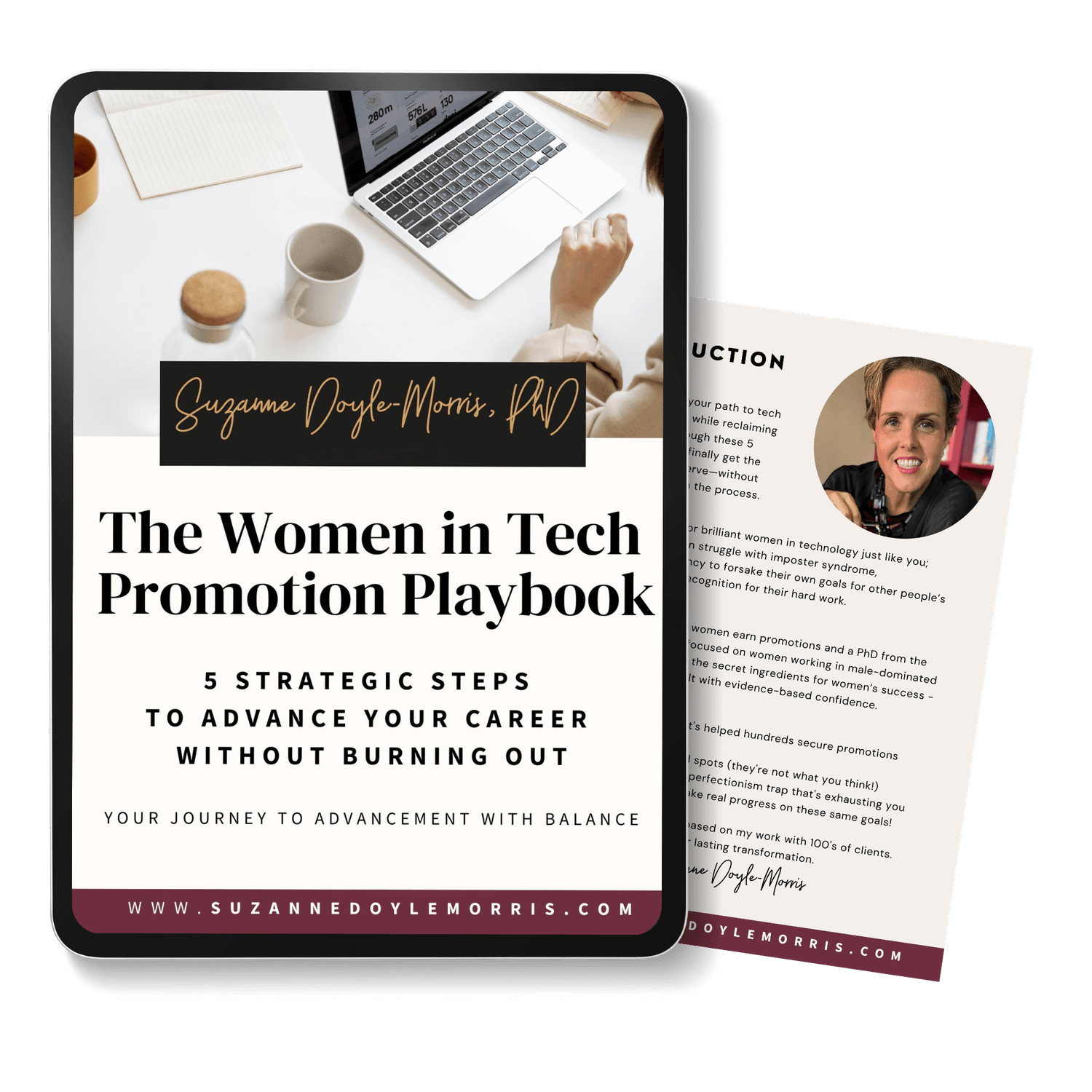
Your roadmap to advancement with balance.
The Women in Tech Promotion Playbook is a practical, evidence-based guide.
It's designed solely for ambitious women in STEM who want to advance their careers without burning out.
Drawing on over 25 years of coaching, research and consultancy, I outline five strategic steps that help women move from being overworked and under-recognised to confident, visible leaders.
Latest on the blog
The Women in Tech Promotion Playbook
Your roadmap to advancement with balance
The Women in Tech Promotion Playbook is a practical, evidence-based guide designed for ambitious women in STEM who want to advance their careers without burning out. Drawing on over 25 years of coaching and research, I outline five strategic steps that help women move from being overworked and under recognised to confident, visible leaders.