For the First Time, She Didn't Want the Promotion. Here's Why.
On the question nobody thinks to ask a lifelong high achiever.
I was standing at the back of a conference room, signing copies of a book I'd spent three years writing.
The ink was barely dry, both on the copies and, frankly, on me. I was exhausted.
A woman picked one up, turned it over, read the back, and looked up with a smile.
"So what's next for you?" Maybe that's a familiar question for you too?
I've been asked that question more times than I can count.
After every one of my books.
After every speaking engagement.
After every significant thing I've ever finished.
And every time, I have to resist the urge to say: 'Can I just stay here for a moment?'
Delivered in a half 'I'm easy and approachable' jest, but half in frustration.
Because here's what that question does, however well-meaning it is.
It implies that what just happened wasn't quite the destination.
That the achievement, the one that took years, that required sacrifice, that kept you up at three in the morning more times than you'd like to admit, was merely a stepping stone and not enough.
And that the stepping stone only counts once you're already moving towards the next one.
Or even identified it; something I can't claim to always have done.
Maybe you can relate?
The session that stopped me cold
I was reminded of this recently in a coaching session with a client I've worked with for some time.
She's senior, technical, a lifelong high achiever in every sense of the phrase.
She came to the session and said something I don't hear often.
"I don't want the next promotion."
Not quietly. Not apologetically. Clearly.
She wasn't burned out. She wasn't giving up.
She wasn't making peace with something she'd failed to get.
She'd simply stopped, properly stopped, for the first time in decades.
A full-on cognisant, eyes wide open choice.
A health scare for her had seen to that.
The months between the diagnosis and the all-clear had a way of rearranging her priorities that no performance review ever had.
And in that space, she'd asked herself a question nobody around her had ever thought to ask.
What do I actually want?
Not what everyone around me think 'naturally comes next'.
But what do I want?
The answer surprised her.
Not because it was small.
But because it had nothing to do with her job title.
She had a new ambition.
It was bigger, more interesting, and more entirely hers than any promotion her organisation could offer.
She just hadn't given herself permission to name it.
After all, it didn't fit the shape of the question she'd always been asked by others and even by herself.
What next? What next? What next?
Here's what I've learned from working with senior women in STEM for over twenty years.
The "what next?" question isn't wrong.
But for lifelong high achievers it becomes automatic.
It's the next reach, the next rung, the next title, without ever stopping to ask whether it's actually the right ladder.
This connects to something I explore in why letting your work speak for itself is costing you the promotion the assumption that the right move is always upward, always faster, always more.
It's an assumption so deeply embedded that most women never examine it.
They don't need to.
The question gets asked for them.
These women aren't restless because they're ambitious.
They're restless because they've been so thoroughly conditioned to keep moving that stopping, even briefly, even to enjoy what they've built.
Let alone ask why it's not fulfilling them in the way they expected, which feels dangerously close to falling behind.
The achievement took years.
The celebration lasts an afternoon, if that.
And then someone, even well-intentioned, asks 'what's next?'.
The difference that matters
As I explore in why "be more confident" is the wrong advice for senior women, the problem is rarely what it looks like from the outside. I
t's not a lack of ambition.
It's the gap between what a lifelong high achiever has been conditioned to want and what she actually wants.
That's a gap that very few people around her will ever help her examine.
The promotion might be exactly the right move.
Or it might simply be the next thing a lifelong high achiever reaches for, automatically, without stopping to ask whether it's actually what she wants.
Those aren't the same thing.
And the difference matters more than most people around you will ever tell you.
If that question; 'what do I actually want?' is one you haven't been asked nearly often enough, I'd love to have a conversation.
Email me at suzanne@doylemorris.com to arrange a chemistry call.
If this resonated, I write about moments like this every week, the ones senior women in STEM recognise immediately and hadn't quite named yet.
Real stories, fresh client insights, and the conversation most people around you aren't having, or perhaps aren't sharing.
Subscribe at suzannedoylemorris.com
Welcome to my Blog

I'm Dr Suzanne Doyle‑Morris and I support professional women working in STEM.
Whether you’re seeking your next promotion, aiming for leadership, or simply looking to make your mark, this blog is created for you.
It's written for the ambitious woman in STEM ready to advance and succeed on her own terms.
Blog Categories
FREE GUIDE
The Women in Tech Promotion Playbook
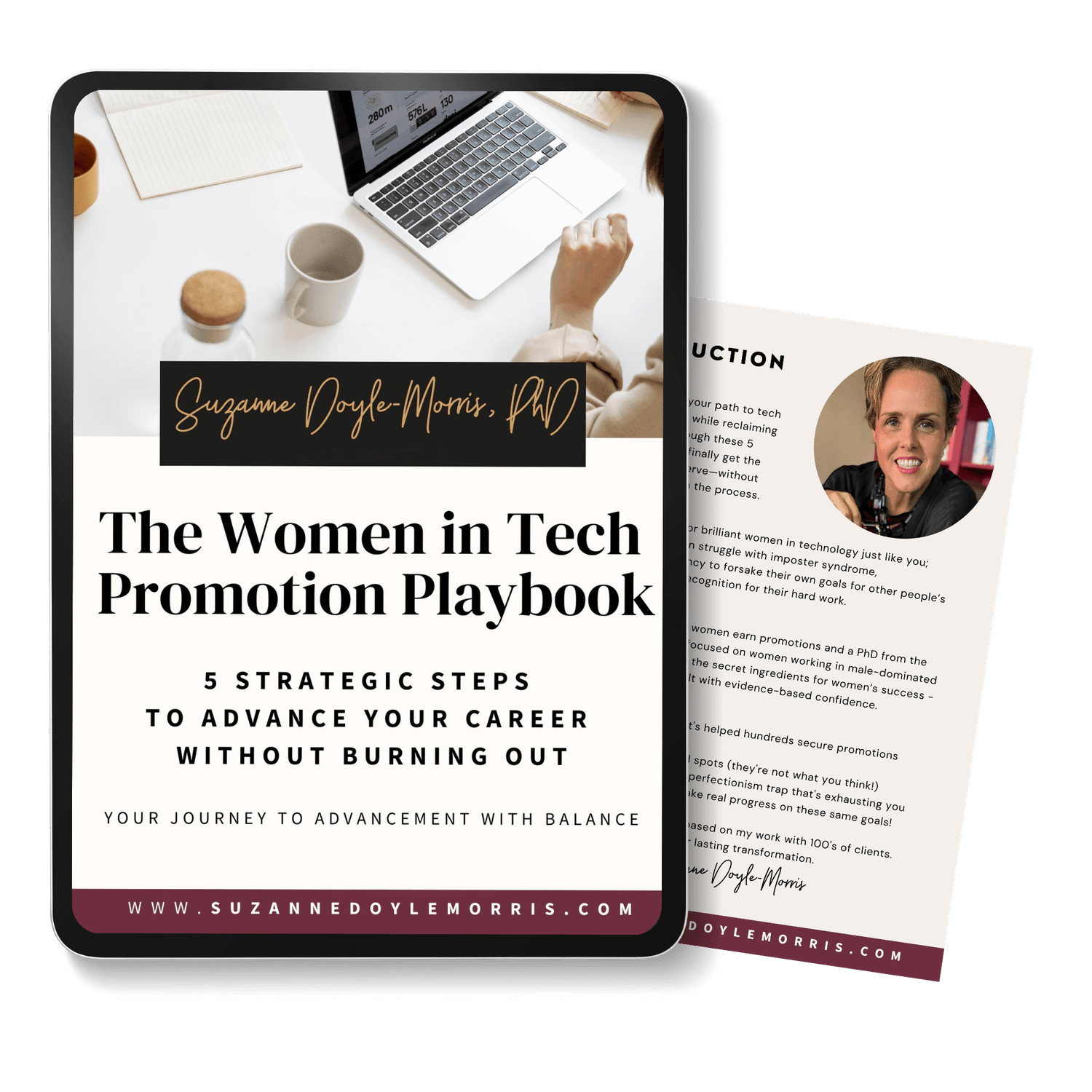
Your roadmap to advancement with balance.
The Women in Tech Promotion Playbook is a practical, evidence-based guide.
It's designed solely for ambitious women in STEM who want to advance their careers without burning out.
Drawing on over 25 years of coaching, research and consultancy, I outline five strategic steps that help women move from being overworked and under-recognised to confident, visible leaders.
Latest on the blog
The Women in Tech Promotion Playbook
Your roadmap to advancement with balance
The Women in Tech Promotion Playbook is a practical, evidence-based guide designed for ambitious women in STEM who want to advance their careers without burning out. Drawing on over 25 years of coaching and research, I outline five strategic steps that help women move from being overworked and under recognised to confident, visible leaders.