Why “Be More Confident” Is the Wrong Advice for Senior Women
The Platitude with a Problem
She had thirty years behind her when she said it. “Why do I bother? If they won’t listen to me and my experience by now, what’s the point?”
This wasn't a junior manager losing her nerve.
It was a senior woman at the top of her field, with nothing left to prove, saying the quiet thing out loud.
And like almost every woman I’ve heard say a version of it, she had, at some point in her career, been told the same well-meaning thing: 'Just be more confident!'
It’s among the most common pieces of advice handed to women at work.
It’s also, in cases like hers, among the most useless, and I want to explain why, because the reason matters more than the slogan.
What the Advice Assumes - And Why it's Wrong
“Be more confident” rests on a single assumption: that the woman is holding back. Her voice, her ideas, her insight.
That the problem lives inside her: in her self-belief, her presence, her willingness to take up space.
Fix the internal setting, the logic goes, and the external problem dissolves. Poof! Almost like a feminist magic potion!
But that’s not what I see in the women I coach. They are not short on self-belief.
They are being challenged more than their colleagues, not less.
The more senior and self-assured a woman becomes, the more she finds herself asked to convince the room, justify the decision, defend the call, and re-prove things she settled years ago.
The confidence is there. It’s often being met with more resistance, not less. After all, she's fought these battles for years.
So the advice doesn’t just miss the mark.
It tells her to repair the one thing that was actually working.
It points inward at exactly the moment the real friction is coming from outside.
That’s why it lands as quietly maddening rather than helpful, because some part of her knows the diagnosis is wrong.
Confidence is internal. Being heard is relational and political.
Any advice that treats the second as if it were the first is solving the wrong equation.
The Part Nobody Names: Your Over-Equipped, not Under-Equipped
Here’s what tends to go unsaid.
The senior women carrying this fatigue are not under-prepared for the challenges wearing them down.
They’re actually over-prepared. The situation that genuinely threw them at thirty-five; the hostile stakeholder, the meeting that went sideways, the credit quietly taken by someone else is something they could now navigate more easily at fifty-five.
Which means the exhaustion isn’t evidence that they can’t cope.
It’s the accumulated cost of being doubted more than everyone around them, for decades.
The competence kept growing. So did the scrutiny.
And the gap between the two is where the tiredness lives.
This is why I don’t treat “why do I bother” as a wobble to be coached away. I treat it as information.
It’s not a failure of confidence.
It’s a rational response to spending thirty years being asked to prove what you proved long ago.
To keep having the same conversations, time and time again.
What Actually Changes Things
If more confidence isn’t the answer, and let's be clear: it isn’t, because there was never a shortage, then what is?
It’s deciding where your hard-won wisdom gets spent, and on whom. Which rooms are worth your energy.
Which battles are worth fighting, and which are simply expensive loyalty to people who were never going to listen, however many years of evidence you put in front of them.
In practice, that almost always comes down to a move you’ve been deferring.
Leaving an organisation that you've been quietly outgrowing or that’s easing you towards an early “retirement” nobody has the honesty to call by its real name.
Or actively positioning yourself with the people who really decide on who gets promotions, rather than waiting to be noticed for work you assume should speak for itself.
The reason these moves get deferred is that they feel as though they require a readiness you don’t yet have.
But the readiness doesn’t come first.
It comes after the move. It's a paradox, but waiting to feel ready is the most reliable way to never go.
The Bit Work isn't Louder. It's Truer.
I work with women in STEM reaching for senior roles and who are discovering the real work has only just started.
That real work is rarely about volume, about being bigger, bolder, more assertive in the meeting.
It’s about reconnecting with the version of themselves for whom everything still felt possible, before the long erosion of being doubted set in.
The women I love working with don’t leave coaching louder.
They leave it feeling more like themselves. They fall back in love with who they are, and from there, the moves they’ve been putting off stop feeling like risks and start feeling like the obvious next step.
So if someone tells you to be more confident, you have my permission to be sceptical.
You were probably never the problem.
The question was never whether you believe in yourself.
It’s where you’ve decided to spend the 'self' you created; after all, it was thirty years in the making.
If this resonated, I write about moments like this every week, the ones senior women in STEM recognise immediately and hadn't quite named yet.
Real stories, fresh client insights, and the conversation most people around you aren't having, or sharing.
Subscribe at suzannedoylemorris.com
Welcome to my Blog

I'm Dr Suzanne Doyle‑Morris and I support professional women working in STEM.
Whether you’re seeking your next promotion, aiming for leadership, or simply looking to make your mark, this blog is created for you.
It's written for the ambitious woman in STEM ready to advance and succeed on her own terms.
Blog Categories
FREE GUIDE
The Women in Tech Promotion Playbook
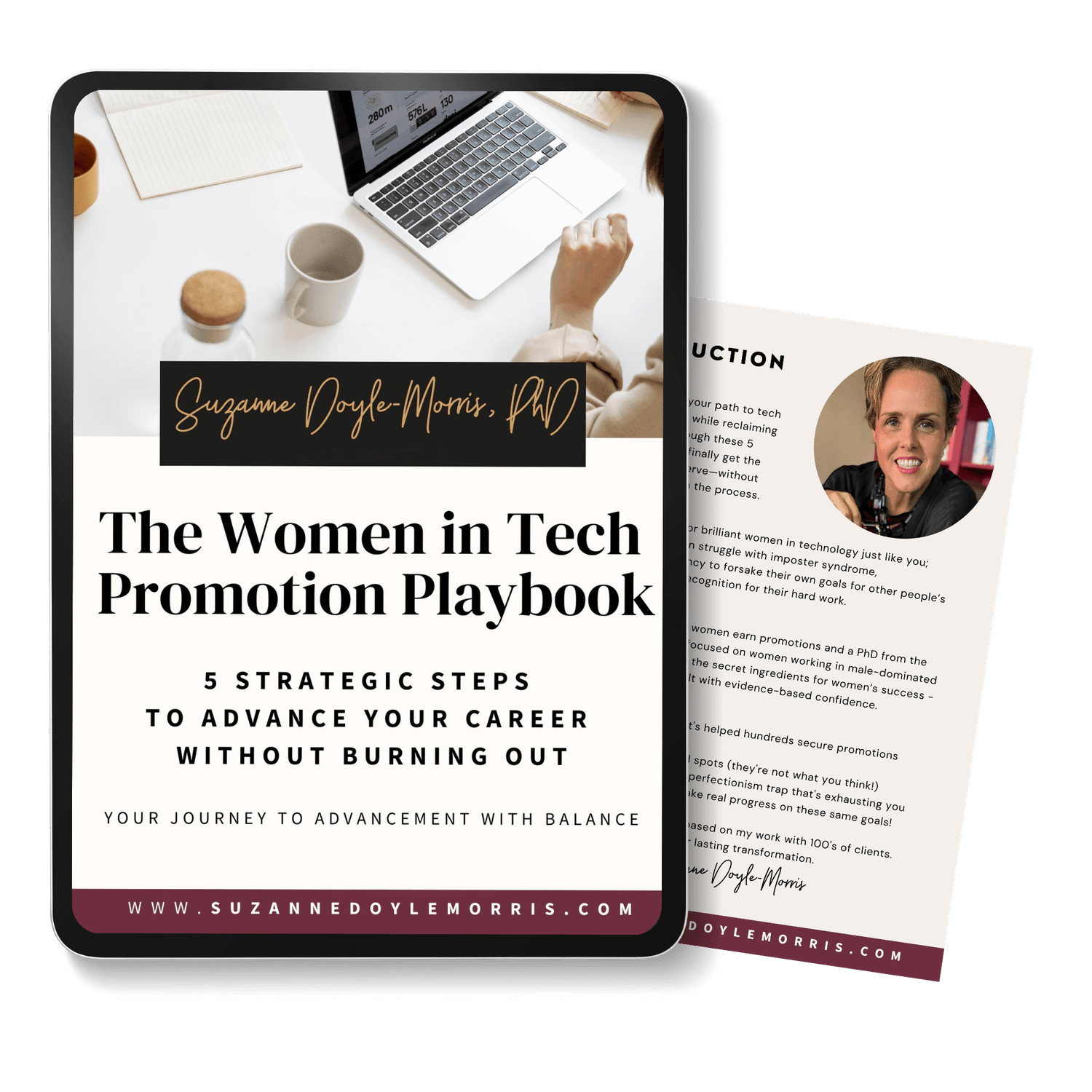
Your roadmap to advancement with balance.
The Women in Tech Promotion Playbook is a practical, evidence-based guide.
It's designed solely for ambitious women in STEM who want to advance their careers without burning out.
Drawing on over 25 years of coaching, research and consultancy, I outline five strategic steps that help women move from being overworked and under-recognised to confident, visible leaders.
Latest on the blog
The Women in Tech Promotion Playbook
Your roadmap to advancement with balance
The Women in Tech Promotion Playbook is a practical, evidence-based guide designed for ambitious women in STEM who want to advance their careers without burning out. Drawing on over 25 years of coaching and research, I outline five strategic steps that help women move from being overworked and under recognised to confident, visible leaders.