Why High-Achieving Women Can't Stop Focusing on What Went Wrong
On the reflex that turns your biggest wins into your biggest blind spot.
I was 8 years old, sitting next to a 'know-it-all' classmate named Tobey.
We'd just got our weekly spelling tests back. Ten words. We'd both scored 80%.
Tobey was delighted. High-fiving the boys within reach, grinning from ear to ear.
Do you think I was delighted? No! Of course not!
I looked immediately for what I'd got wrong.
I don't remember which two words I'd missed.
I just remember the reflex; that automatic scan for my wrong words, the letters I'd missed, my mistakes, not giving a thought to the majority of the words I'd actually aced.
That was forty-something years ago.
But it sits with me and my clients as they too often resonate with that little girl's experience.
We are still too often that little girl, fuming in the classroom.
Fuming at myself, and fuming in the disbelief at how delighted Tobey appeared.
I've told this story to hundreds of women in corporate settings, professional membership groups, and conference rooms across five countries. And the reaction?
Every single time: laughter, nodding, the particular smile of recognition that says oh, that's me. I remember her!
Because one think I've learned; every woman has her own 'Tobey'.
Maybe you had several.
Maybe you can relate?
The bar that keeps moving
That's the thing about being someone who holds herself to high standards: the bar moves the moment you clear it. 80% becomes the floor, not the ceiling.
The two wrong words get more emotional and cognitive airtime than the eight right ones.
I see this constantly in my executive coaching work with senior women in STEM.
They arrive having just received a glowing performance review and lead in our discussion, almost without exception, with the one thing that wasn't perfect.
The single piece of 'developmental feedback' or 'constructive criticism' in an otherwise stellar appraisal.
The moment that didn't land the way they'd hoped in a presentation that was, by every other measure, exceptional.
This connects directly to a pattern I explore in why letting your work speak for itself is costing you the promotion.
It's the same conscientiousness that makes you exceptional at your job can make you invisible to the people who need to see your wins.
These women are not short of achievement. They are short of giving themselves permission to celebrate their 80%.
Or even to recognise that they've likely been told that their 80% is often better than the 100% of others.
The irony nobody mentions
The irony is that the very standard that drives them to excellence is the same one that stops them seeing how far they've actually come.
As much as it pains me to write this: Tobey wasn't less rigorous.
He just hadn't learned yet to discount his own wins before anyone else could.
Most of us learned that lesson too well, and too young.
It shows up everywhere.
In the woman who can't stop ruminating over a career decision that everyone around her considers settled.
In the one who deflects every compliment before it can land.
In the one who arrives at a coaching session with a list of what she hasn't done yet, when the evidence of what she has done fills the room and our subsequent discussion.
What holding up a mirror actually looks like
The work of executive coaching for senior women in STEM is not about adding more.
It's about helping someone see what's already there clearly, without the automatic discount.
That means sitting with someone while she reads the eight right words instead of rushing to the two wrong ones.
It means asking: what would you say to a colleague who'd just received this feedback?
And watching her realise she'd never speak to anyone else the way she speaks to herself.
The bar doesn't need to be lowered, the reflex we learned as children just needs to be noticed.
Does this sounds familiar?
If you're someone who raises the bar the moment you clear it and can't quite remember the last time 80% felt like enough, I'd love to have a conversation.
The senior women in STEM I work with aren't short of capability.
They're short of someone who can hold up a mirror and show them what's actually there and how to build on it.
If that's you, email me at suzanne@doylemorris.com to arrange a chemistry call.
Welcome to my Blog

I'm Dr Suzanne Doyle‑Morris and I support professional women working in STEM.
Whether you’re seeking your next promotion, aiming for leadership, or simply looking to make your mark, this blog is created for you.
It's written for the ambitious woman in STEM ready to advance and succeed on her own terms.
Blog Categories
FREE GUIDE
The Women in Tech Promotion Playbook
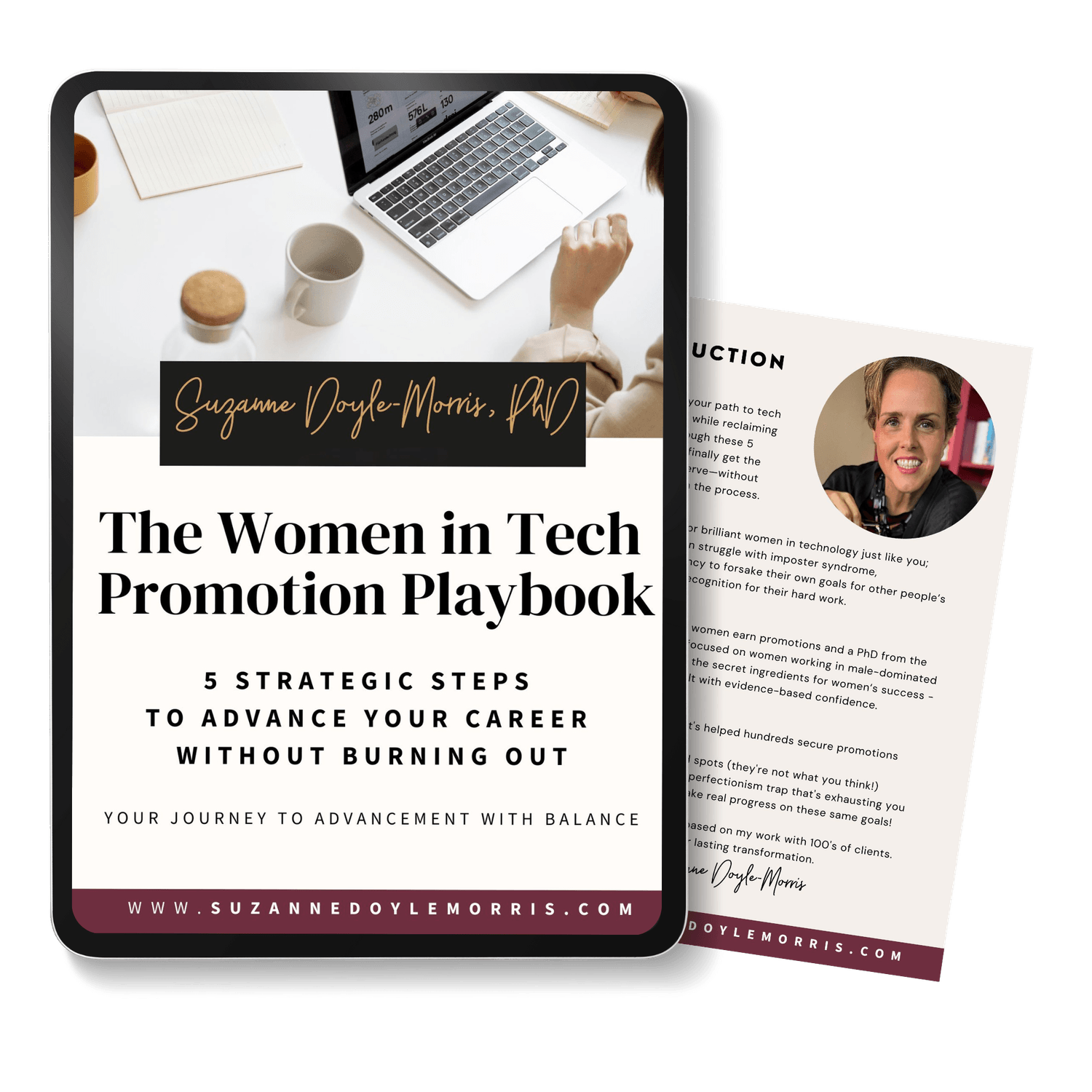
Your roadmap to advancement with balance.
The Women in Tech Promotion Playbook is a practical, evidence-based guide.
It's designed solely for ambitious women in STEM who want to advance their careers without burning out.
Drawing on over 25 years of coaching, research and consultancy, I outline five strategic steps that help women move from being overworked and under-recognised to confident, visible leaders.
Latest on the blog
The Women in Tech Promotion Playbook
Your roadmap to advancement with balance
The Women in Tech Promotion Playbook is a practical, evidence-based guide designed for ambitious women in STEM who want to advance their careers without burning out. Drawing on over 25 years of coaching and research, I outline five strategic steps that help women move from being overworked and under recognised to confident, visible leaders.