Every Hand Went Up. Then They Slowly Came Down.
What one question to a room of Cambridge researchers revealed about moving goalposts.
I asked over a dozen Cambridge researchers whether they'd been delighted to get the job they have now.
Every hand went up.
Then I asked a second question, and watched almost every hand come down.
Back in Cambridge
I'd been invited back to Cambridge, where I did my PhD, to run my session Bounce Forward: Unlocking Resilience through Uncertainty for early-career researchers, all from STEM subjects.
It's a session I've run many times.
But this room needed it more than most.
UK academics are under a particular kind of strain right now.
Funding that may not be renewed.
Workloads that would make a management consultant wince.
Romantic relationships that may stall for years, because two experts must live in different parts of the world simply to progress in their specialism.
And at Cambridge, there's an extra twist.
These researchers know they're somewhere most academics would give their right arm to be.
So the self-doubt is palpable, and every wobble feels like ingratitude.
The Pressure to Publish
I told them I could identify.
I only left academia, I joked, because I feared the pressure to publish.
Then I rolled my eyes and showed them the three books I went on to write anyway: practical ones, for ordinary readers rather than academics.
They groaned. They knew that pressure only too well.
The joke had some truth in it.
By the end of my PhD, I was thoroughly sick of writing.
The idea of doing more felt faintly masochistic.
And I couldn't shake the feeling that one journal article, read by a tiny academic audience, would have far less impact than speaking with thousands of people.
So I didn't write my first book until five years after I'd left Cambridge.
I needed the break before I could fall back in love with writing, and remember how much I loved research!
For the postdocs and early-stage lecturers in that room, there's no such break.
They're assessed constantly.
Judged on their publication output, and on what their research yields, which isn't always in their control.
For those from under-represented backgrounds, it all compounds via the "paradox of hyper-visibility".
They're highly visible as a minority, yet strangely invisible when it comes to progression.
They're less likely to hold open-ended contracts, and still grossly under-represented at professorial level.
Covid hit them hardest too: visa uncertainty meant missed conferences, family obligations piled up, and plans went on indefinite hold.
The numbers make me furious.
Every Hand Went Up
So, partway through the session, I asked them: how many of you were delighted with the role you have now when you got it?
Every hand went up.
Then: how many of you are still equally excited by it?
Barely a hand stayed up.
Nobody needed me to explain what had just happened.
They'd seen it in their own raised arms.
Our goalposts for happiness keep moving.
The moment we get the thing we wanted, we quietly raise the bar, and push back the date when we'll finally feel satisfied.
Psychologists call it the hedonic treadmill.
I call it the reason so many brilliant people feel vaguely discontented in jobs they once dreamed of.
It isn't ingratitude. It's how we're wired.
But it helps enormously to notice it happening.
Questioning it slows it down, and that builds resilience.
The Goalpost Everyone's Aiming For
I've been musing on something since.
Almost everyone in that room will be aiming, consciously or not, for the traditional summit: a permanent post, a lab of their own, perhaps a professorship.
Statistically, most of them won't get there. Gulp.
Many will leave academia for commercial roles, which is every bit as valid.
After all, industry badly needs what they know.
And for those who do get there, the "reward" for being good at research is often to recruit, fund and manage an entire lab team.
A whole new job, and one nobody trained them for.
If the goalpost is going to move anyway, it's worth asking who put it there in the first place.
Bouncing Forward, Not Back
"Bouncing back" suggests returning to where you were.
I'm far more interested in where you go next.
In the session, we looked at the inner voices that talk us down, and at finding the gift in a challenge none of us would ever have chosen.
And we finished on the idea I most wanted them to take home: you've already been through a lot.
Which means you can do it again, and smarter.
A few of them stayed behind afterwards to talk.
Maybe You Can Relate?
Think back to the role you have now. The day you got it.
Were you delighted? And are you still?
If the honest answer is "not quite", you're not ungrateful.
You're human. Perhaps the goal you're chasing next is perfect, but often it isn't the one you actually want.
Or perhaps you're still carrying a label you picked up early: the clever one, the reliable one, the one who never struggles.
The goalposts will keep moving. You don't have to keep chasing them.
Within 12 months of our coaching partnership, 80% of my clients secure a promotion or other career enhancement.
I'm Dr Suzanne Doyle-Morris, an ICF Master Certified Coach with a PhD from Cambridge. For 25 years I've helped experienced women work out which goalposts are actually theirs.
I write about moments like this every week in my newsletter.
You can subscribe on the front page of this website.
And if you'd like to talk about what's next for you, e-mail me at suzanne@doylemorris.com.
Welcome to my Blog

I'm Dr Suzanne Doyle‑Morris and I support professional women working in STEM.
Whether you’re seeking your next promotion, aiming for leadership, or simply looking to make your mark, this blog is created for you.
It's written for the ambitious woman in STEM ready to advance and succeed on her own terms.
Blog Categories
FREE GUIDE
The Women in Tech Promotion Playbook
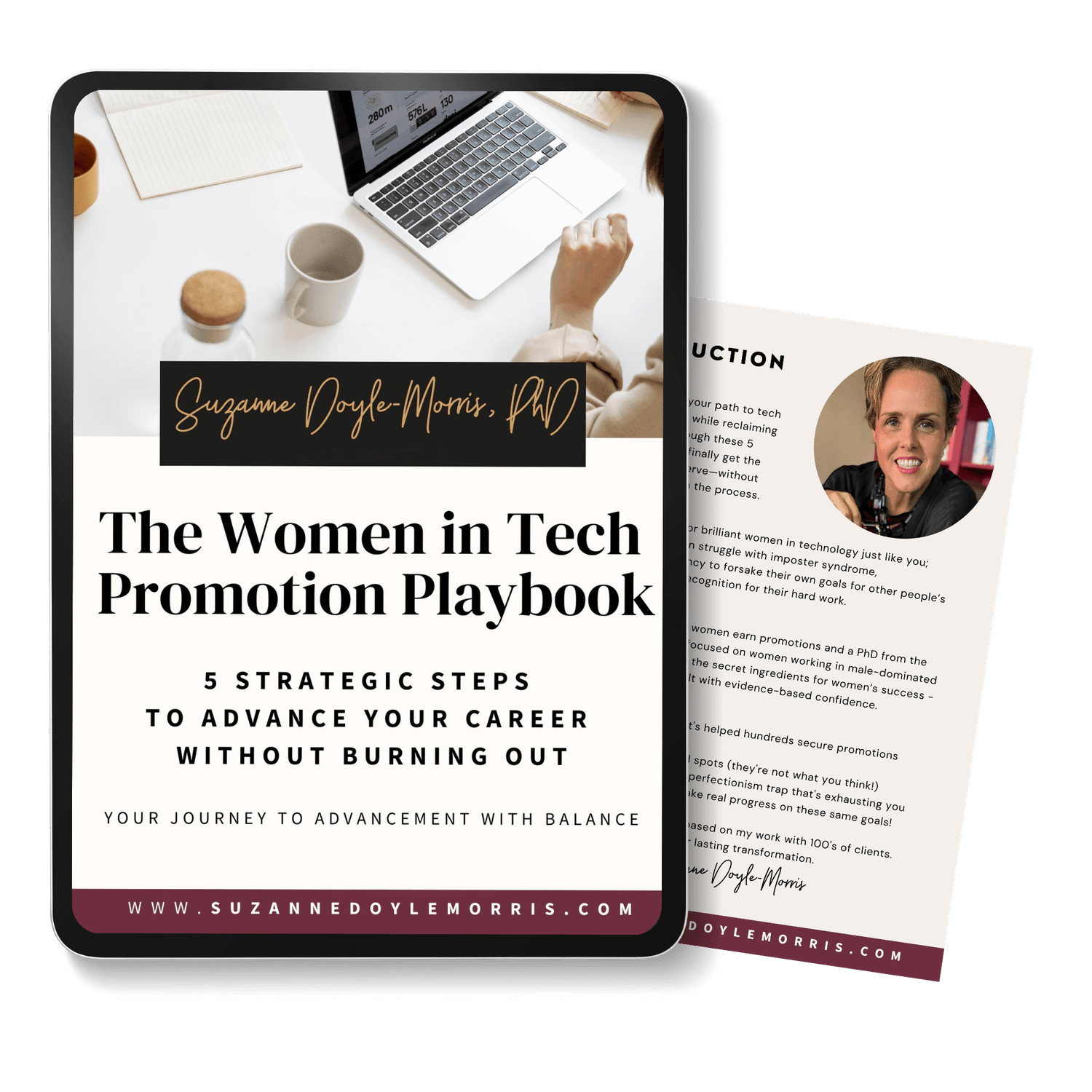
Your roadmap to advancement with balance.
The Women in Tech Promotion Playbook is a practical, evidence-based guide.
It's designed solely for ambitious women in STEM who want to advance their careers without burning out.
Drawing on over 25 years of coaching, research and consultancy, I outline five strategic steps that help women move from being overworked and under-recognised to confident, visible leaders.
Latest on the blog
The Women in Tech Promotion Playbook
Your roadmap to advancement with balance
The Women in Tech Promotion Playbook is a practical, evidence-based guide designed for ambitious women in STEM who want to advance their careers without burning out. Drawing on over 25 years of coaching and research, I outline five strategic steps that help women move from being overworked and under recognised to confident, visible leaders.