Why Working Harder Stops Working — And What to Do Instead
The gap between knowing how to work hard and knowing how to struggle is one nobody warns you about.
In 2003, I was preparing to defend my PhD at Cambridge. My research was on the 'Experiences of women and non-UK nationals in UK engineering programmes'.
Like all PhD's, it was a tight, highly specific niche that only its author could love. I'd lived inside the topic for 3 years, and genuinely loved what I was learning and more importantly, the type of detail-oriented, no-nonsense people I was meeting.
When the day came for me to defend my Viva, I was nervous, but it actually felt less like an examination and more like a conversation with someone who shared my obsession of getting more women into these fields. Our discussion was energising, even fun. Or at least fun for a nerd like me, and perhaps like a lot of you.
How'd I leave that meeting? 'Quietly confident' as my favourite bit of British understatement goes.
However, in the run up to that prep, I was also failing to master the art of what I could only term my 'Hellish Hill Start'. We'd moved to the countryside, which meant walking or even cycling to classes, particularly through all Cambridgeshire weathers, was no longer on the cards.
So I had to learn how to drive — a manual. After all, that's what we'd been gifted by my fiancé's father. We were on a tight budget, so I had no other option. Buses from our village or an automatic car were out.
Manual was in. My fiancé was patient. I was not. In an effort to assure we got to the altar, we diplomatically agreed I'd be better off with formal lessons — from a driving instructor.
A lifelong driver of automatics, what I didn't anticipate was how hard making that switch would turn out to be. I took lesson after expensive lesson. More than I'd budgeted for and certainly more than I felt 'fair' given the amount of time I was putting in.
In the end, I passed my driving test on the first attempt, which sounds better than it was. In reality, I passed it with the maximum number of minor faults you can accumulate and still scrape by. I cried with relief in the car park afterwards.
But before any of that, a few lessons in, my instructor said something I've never forgotten.
He gave me a knowing look and said:
"You're not someone who's used to struggling with things, are you?"
He was right. And the thing that stopped me cold wasn't that he'd noticed. It was that I hadn't.
I wasn't struggling with driving. I was 'struggling with struggling'.
Working harder and thinking more carefully had always been my answer to everything.
My hard work and thinking skills weren't helping here.
And I had absolutely no idea what to do with that struggle on something I'd assumed I'd manage.
After all, I had breezed through the written examination.
Maybe you can relate?
The gap nobody talks about at senior level
That's the thing about being someone who's always figured things out: you expect the new hard thing to yield to the same effort that everything else yielded to.
When it doesn't, it doesn't just feel difficult. It feels wrong. Like a sign that something's broken. Maybe even that you're broken.
It isn't. It's just a different kind of learning.
Here's what my driving instructor understood that I didn't: the women I work with are not short of intelligence, effort, or commitment.
What catches them out is the gap between knowing how to work hard and knowing how to work through something that isn't working.
This is one of the patterns I explore in why letting your work speak for itself is costing you the promotion — the same drive that built your career can quietly become the thing that limits it.
Those are different skills.
And the second one doesn't come naturally to people who've spent decades being very good at the first.
Don't switch to automatic
The temptation, when you're in the middle of it, is to 'switch to automatic'. To stop doing the hard thing and find the easier, quicker version, perhaps the way you already know and that feels comfortable. To lower the bar because the original one is taking longer than expected.
This shows up in recognisable ways: staying in a role that no longer fits because at least you're good at it; avoiding the conversation that feels genuinely hard; doing everything yourself because delegating feels slower.
The inner critic gets louder precisely when you're trying something new — and for high-achieving women, that voice can be formidable.
But the freedom on the other side, when you've driven that manual, passed that test, sat in that car park in tears of relief and then pulled out into the road? That is something that the automatic version simply cannot give you.
But don't switch to 'automatic'.
The satisfaction when you finally get there is immense and beyond compare.
Working with someone who can see what you can't
Senior women in STEM are rarely stuck because they lack intelligence or commitment. They are stuck because they are standing in the middle of a pattern they cannot see from the inside, applying the tools that have always worked to a problem that requires something different.
That is precisely what executive coaching for senior women in STEM addresses. Not another framework. Not more effort applied to the same approach.
A thinking partner who can see the pattern you're standing in the middle of and help you find a way through your own 'hill starts'.
Sound familiar?
if you're someone who's always figured things out, and you've hit the thing that isn't yielding I'd love to have a conversation.
If that's you, email me at suzanne@doylemorris.com to arrange a chemistry call.
Want perspectives like this weekly?
Subscribe to my newsletter for senior women in STEM on the front page of this website.
Welcome to my Blog

I'm Dr Suzanne Doyle‑Morris and I support professional women working in STEM.
Whether you’re seeking your next promotion, aiming for leadership, or simply looking to make your mark, this blog is created for you.
It's written for the ambitious woman in STEM ready to advance and succeed on her own terms.
Blog Categories
FREE GUIDE
The Women in Tech Promotion Playbook
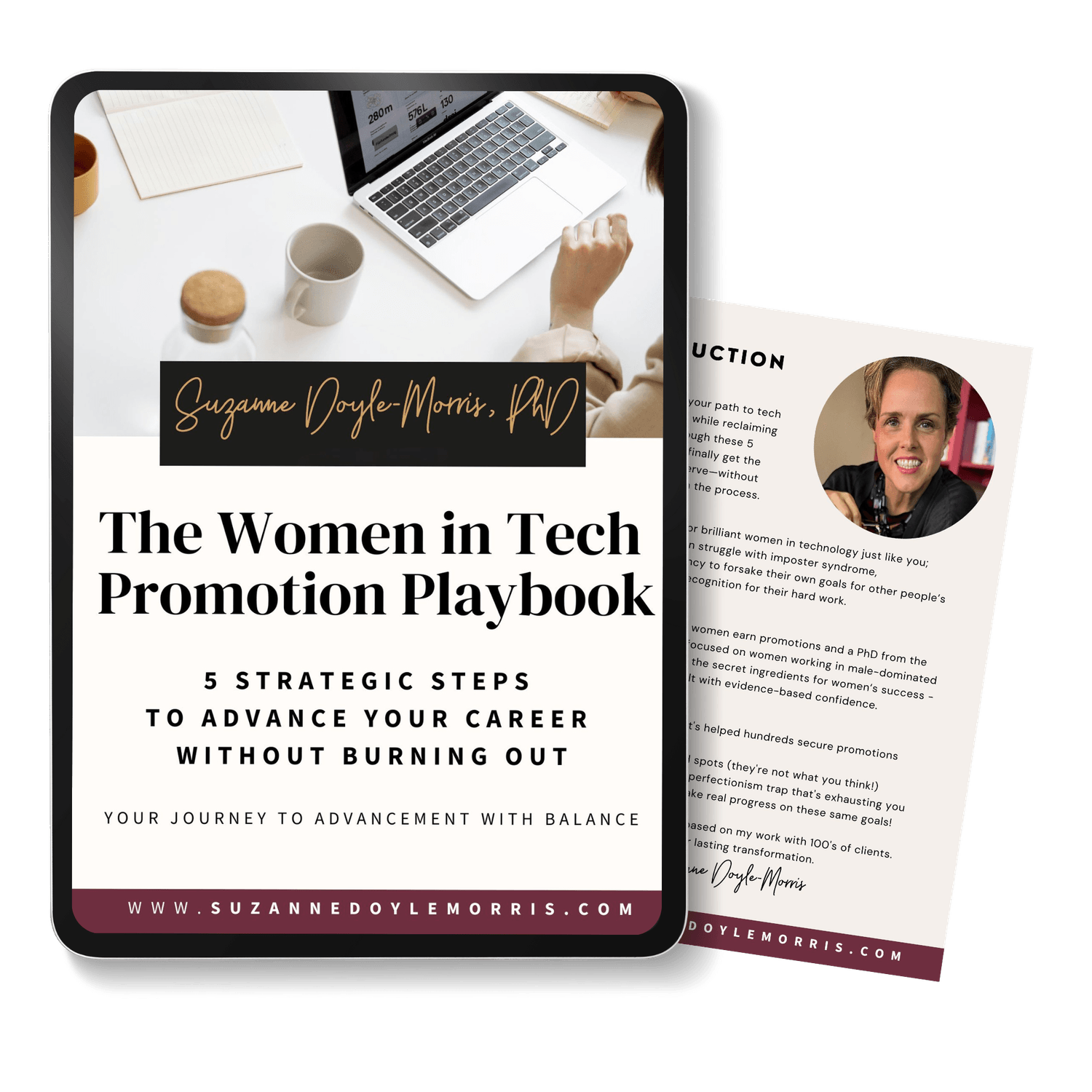
Your roadmap to advancement with balance.
The Women in Tech Promotion Playbook is a practical, evidence-based guide.
It's designed solely for ambitious women in STEM who want to advance their careers without burning out.
Drawing on over 25 years of coaching, research and consultancy, I outline five strategic steps that help women move from being overworked and under-recognised to confident, visible leaders.
Latest on the blog
The Women in Tech Promotion Playbook
Your roadmap to advancement with balance
The Women in Tech Promotion Playbook is a practical, evidence-based guide designed for ambitious women in STEM who want to advance their careers without burning out. Drawing on over 25 years of coaching and research, I outline five strategic steps that help women move from being overworked and under recognised to confident, visible leaders.