What to Do When You've Been Overlooked for Promotion
On turning the promotion you didn't get into the role you actually wanted.
Tracey had been in her role at a software company for years.
She knew the work inside out. She knew the clients. She knew the culture. She'd built relationships that took a decade to earn.
And then the promotion she'd been working towards went to Trevor.
I could feel her anger, disgust and disbelief coming through the computer as we spoke.
Trevor, who had been there for a fraction of the time.
Trevor, who — as Tracey angrily put it in our session — "hadn't even bothered to learn half the names of the people he'd be leading."
So clearly, she arrived at our session furious.
Completely understandable.
But fury, as I've learned from twenty years of executive coaching for senior women in STEM, is rarely the most useful place to stay.
So we sat with it. And then we started to look at what was actually in front of her now.
The thing about being overlooked
That's the thing about being overlooked: the initial sting can blind you to what's actually happened — and what might now be possible.
This connects to a pattern I write about in when your boss won't listen.
It's when the system doesn't respond the way you expected, the instinct is to push harder in the same direction.
But sometimes the more strategic move is to look at what's shifted, and what that opens up.
As Tracey talked through Trevor's new responsibilities, something shifted in her.
She began to notice the parts of the role she'd coveted that she was now watching him flounder through.
The external stakeholder management that consumed so much of his time. The board reporting that kept him in meetings every Friday.
The parts of the job, she realised, that had never actually interested her. She'd only do them if she had been 'awarded' the job.
Something that was no longer seeming like the 'prize' she assumed it would be.
The responsibilities that had actually interested her were the internal clients; the colleagues she'd known for years, the relationships that actually made the work matter.
Trevor, it turned out, wasn't particularly focused on those 'repsonsibilities'.
In fact, he'd never valued those tasks in the first place.
From fury to strategy
Tracey stopped being angry. She started being strategic.
She began quietly taking on the internal client work that Trevor considered peripheral.
The conversations he didn't want to have. The relationships he didn't have time to build.
She made herself indispensable to the people who mattered most to how the work actually got done.
This is the move that women who stop waiting for recognition eventually learn to make.
Not performing for the people who aren't watching, but becoming essential to the ones who are.
And then she made the case.
Clearly, calmly, with her hard-earned evidence that the role was too big for one person.
That the external and internal client responsibilities required different skills, different approaches, and different relationships.
And because to Trevor, she was actually taking things off his plate, he was more supportive than she'd first anticipated he'd be.
After all, she wasn't asking for a consolation prize.
She was describing a structure that was already emerging.
Always a 'smart cookie' as my mother would have said, Tracey was just positioning herself as the obvious person to lead the half of the role she'd always been best at and enjoyed the most.
What this looks like from the outside
The senior women in STEM I work with through executive coaching aren't short of capability or commitment.
What they sometimes need is someone to help them see past the fury to what's actually there, and what might now be possible because of a decision that didn't go their way.
Being overlooked is painful. It's also, sometimes, valuable information.
About what the organisation values, about what you actually want, and about where your real leverage lies.
Tracey didn't get the promotion she'd expected.
She got something more useful: clarity about what she actually wanted, and a strategy to get it.
If that's you; if you've been overlooked, passed over, or had the rules changed without warning I'd love to have a conversation.
The senior women in STEM I work with aren't short of capability.
They're short of someone who can help them see past the fury to what's actually possible.
Email me at suzanne@doylemorris.com to arrange a chemistry call.
Welcome to my Blog

I'm Dr Suzanne Doyle‑Morris and I support professional women working in STEM.
Whether you’re seeking your next promotion, aiming for leadership, or simply looking to make your mark, this blog is created for you.
It's written for the ambitious woman in STEM ready to advance and succeed on her own terms.
Blog Categories
FREE GUIDE
The Women in Tech Promotion Playbook
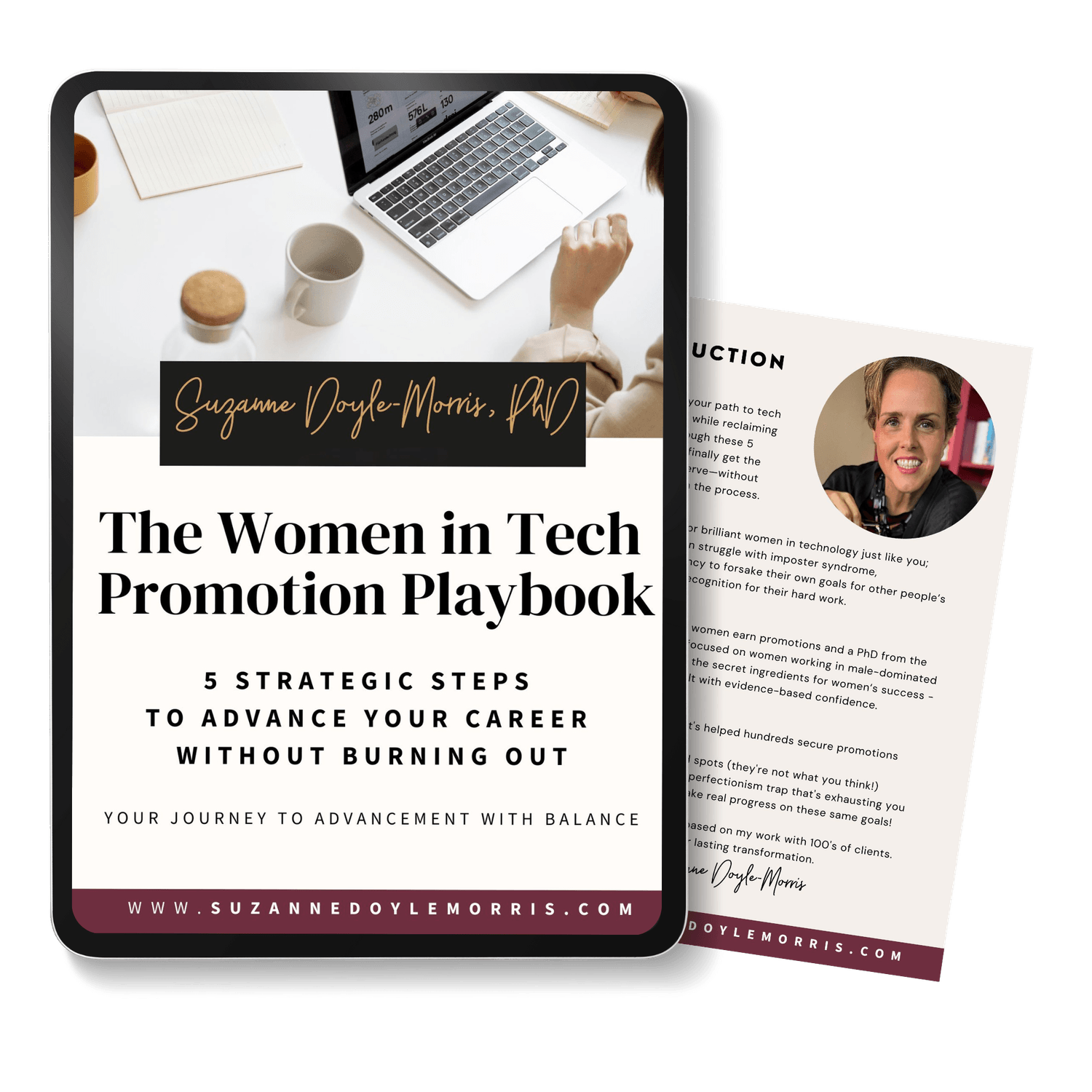
Your roadmap to advancement with balance.
The Women in Tech Promotion Playbook is a practical, evidence-based guide.
It's designed solely for ambitious women in STEM who want to advance their careers without burning out.
Drawing on over 25 years of coaching, research and consultancy, I outline five strategic steps that help women move from being overworked and under-recognised to confident, visible leaders.
Latest on the blog
The Women in Tech Promotion Playbook
Your roadmap to advancement with balance
The Women in Tech Promotion Playbook is a practical, evidence-based guide designed for ambitious women in STEM who want to advance their careers without burning out. Drawing on over 25 years of coaching and research, I outline five strategic steps that help women move from being overworked and under recognised to confident, visible leaders.