\"We Doyles Aren't Good at Numbers\" and What It Cost Me to Believe It
The sentence I swallowed like a truth
When I started my PhD in 1999 (last century, as I have to remind myself, rather soberingly) one of the first hard questions I faced was how I'd collect my data.
As I completed my Master’s I was given just two choices. I could either do so qualitatively, through interviews, or quantitatively, through numbers and statistics.
It should have been an easy choice.
I loved reading and writing as a teenager.
Indeed, even in the 20 years since my PhD, I've spent the subsequent twenty years writing books, interviewing stakeholders, listening to clients and helping them make meaning of what they are sharing with me and indeed the truths they are hearing themselves say!
So qualitative work is where my heart lives. A choice of qualitative would have been a sheer joy.
But I'd grown up inside a particular sentence. My mother said it often, lightly, without malice: "We Doyles, we're no good at maths."
She’d meant it kindly, as if by explanation for my struggle when faced with learning division and then later, algebra and so on and so forth.
However, she’d also say the ‘self-evident truth’ while I watched her balance a chequebook to the penny. While keeping a family of four fed on the £11.40 left until my father's next payday.
The evidence of her own competence was right there in her hands. Yet, the story she told about our collective skills said the opposite.
And I'd swallowed the story whole. I avoided maths at school, never noticing I was actually rather good with money as a child: budgeting, saving, knowing exactly what change I was owed by the cashier.
Getting excited by compound interest in my small savings account even! The sentence had done its work long before I thought to question it.
The choice that wasn't a choice
So when that data-collection question was posed to me, the one I knew would shape the next three years of my life, I realised what believing the sentence had been quietly costing me.
I could keep living inside the inherited story.
Or I could challenge that self-limiting belief and create a new one for myself.
So I pulled my big-girl pants on and chose the quantitative route.
The hard choice. The one that both frightened me and filled me with awe.
In my thesis I justified it on its merits; that numbers let you spot patterns across whole populations, see what holds true at scale, understand groups rather than individuals. All true.
But underneath the academic justification was something far more personal: I was refusing to be someone who ‘couldn't do maths’.
When the data I ran finally came in two years after that fateful choice; the t-tests, the ANOVAs, the survey results from over a thousand quantitative surveys from MEng students across ten UK universities,
I remember the feeling exactly. Like Christmas morning!
I pored over those spreadsheets like a ‘data buffet’ laid on just for me.
I was ready to ‘eat all I could eat!’ to see what any patterns could tell me!
What the numbers actually meant
Here's what I was looking for: what, if anything, made the difference between the few women on those engineering courses and their male peers.
The most striking finding was more telling than I'd even expected. The women were statistically more likely than the men to have had a mentor.
They were slightly, but in a way that was statistically significant, more likely to have someone who'd shown them what a career in engineering could actually offer.
A relative, a family friend, a teacher who saw the potential in them.
By contrast, the men, by and large, had drifted into the topic. Through hobbies, through being good at science or maths at school, through a world that quietly assumed engineering was for them.
The women were more likely to have benefitted from someone pointing at the Engineering option and saying: ‘that door’s open to you too!’
That finding has never left me. It's not far off the whole reason I do what I do now.
The two things I carry from it
The first is about inherited stories. Most of us are living inside a sentence someone else said about us.
Beliefs like: “We're not a numbers family," "I'm not a natural leader," "I think you’re born with presence or you're not."
And like my mother balancing her chequebook, the evidence against the sentence is often right there in our own hands, unnoticed.
The work isn't acquiring a new ability. It's catching the old story in the act and challenging what you’ve assumed to be true.
The second is about doors. Almost nobody finds the open door on their own.
The women in my study didn't lack the ability. Instead, they lacked, until someone provided it, the simple knowledge that the door was theirs to walk through.
That's true at every level, including the most senior.
The senior women I work with are rarely short of capability. What changes things is someone showing them which door was always open.
I chose the hard method to prove a sentence wrong about myself. It ended up teaching me what I'd spend the next two decades doing for other people.
Want the deeper version of this?
My free Women in Tech Promotion Playbook walks through exactly how senior women get past being doubted.
How they position themselves with the people who decide promotions, and stop waiting to be noticed for work that should speak for itself.
Welcome to my Blog
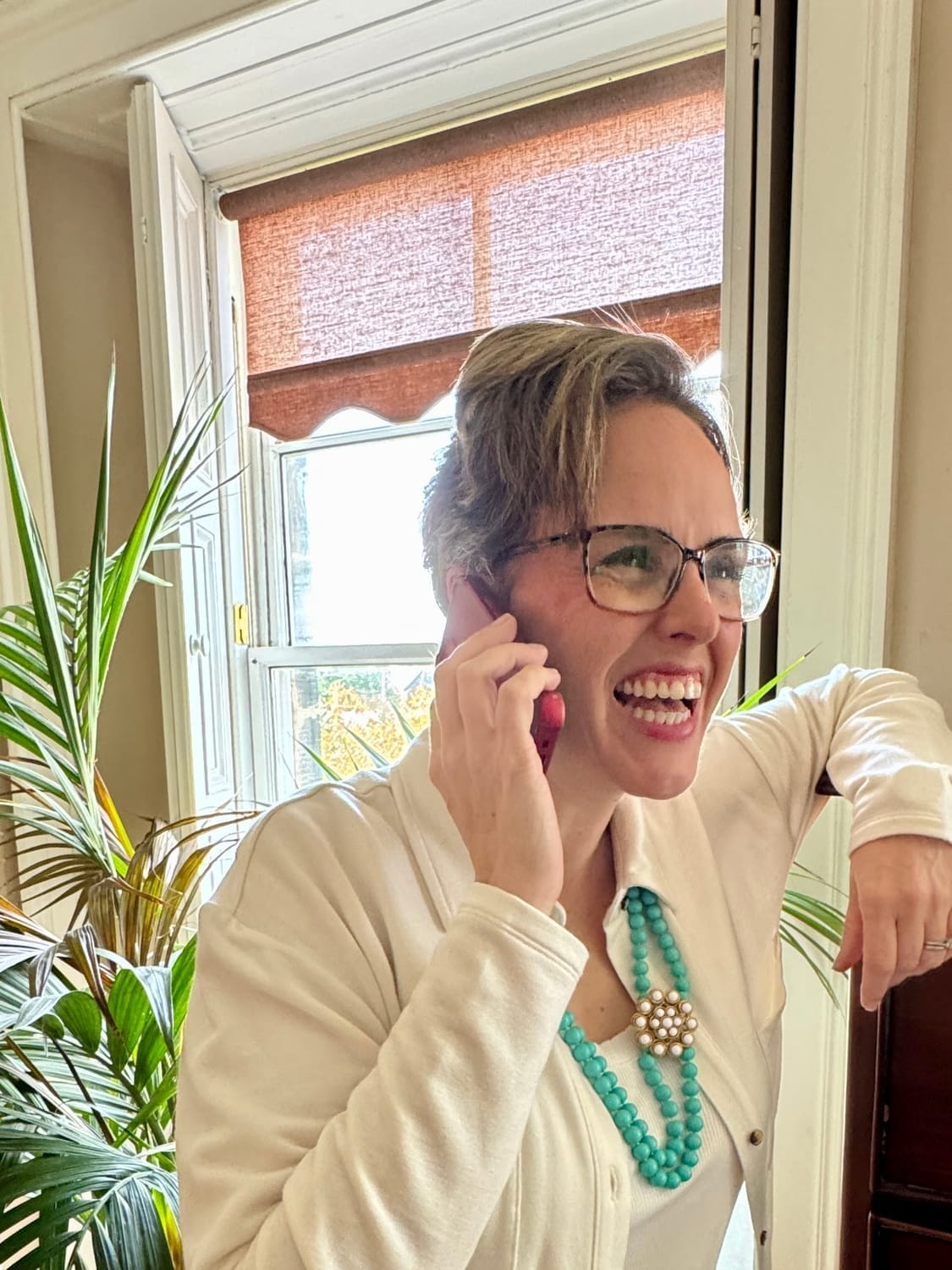
I'm Dr Suzanne Doyle‑Morris and I support professional women working in STEM.
Whether you’re seeking your next promotion, aiming for leadership, or simply looking to make your mark, this blog is created for you.
It's written for the ambitious woman in STEM ready to advance and succeed on her own terms.
Blog Categories
FREE GUIDE
The Women in Tech Promotion Playbook
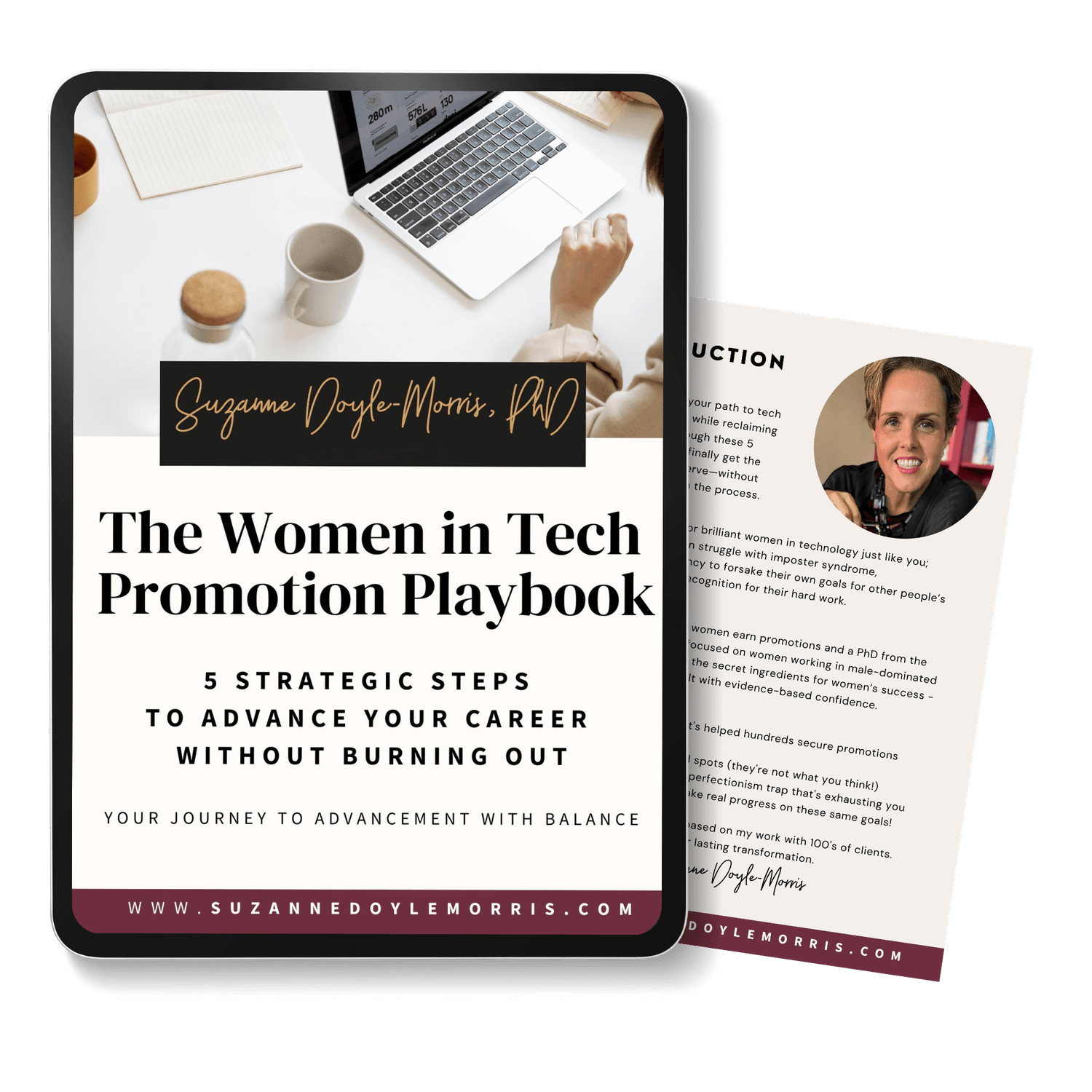
Your roadmap to advancement with balance.
The Women in Tech Promotion Playbook is a practical, evidence-based guide.
It's designed solely for ambitious women in STEM who want to advance their careers without burning out.
Drawing on over 25 years of coaching, research and consultancy, I outline five strategic steps that help women move from being overworked and under-recognised to confident, visible leaders.
Latest on the blog
The Women in Tech Promotion Playbook
Your roadmap to advancement with balance
The Women in Tech Promotion Playbook is a practical, evidence-based guide designed for ambitious women in STEM who want to advance their careers without burning out. Drawing on over 25 years of coaching and research, I outline five strategic steps that help women move from being overworked and under recognised to confident, visible leaders.