She Kept Calling Herself 'Selfish'. It Was Actually the Most Generous Thing She Could Do.
On the guilt of making time for your own career, and why it's misplaced.
A year ago, she admitted something to her husband: "I just don't know what to do."
New for her. Maybe new for you?
If you knew her, you'd understand why that unsettled her.
As he reassured her, she always "knows what to do. And when she doesn't, she knows how to work it out."
But she had just been passed over for the leadership role she'd been working towards, and the feedback stung.
Apparently, she wasn't deemed strategic enough.
"Too focused on processes," the most senior bigwigs complained.
Yet one year later, she was about to step into a version of that very job, voted in by her peers, co-leading her department alongside a colleague she'd chosen with real care.
To unnerve her further, a former competitor told her she'd picked the wrong partner.
You'll be no more surprised than I was to find her killer tactic for that guy was to ignore him.
As she started the new shared role, she began by asking her colleagues what they needed, and most of them found space in their very busy diaries to tell her.
No surprise there, as people love giving their opinions.
The message coming back, again and again, was that these colleagues wanted clearer processes.
They wanted to understand how decisions actually got made.
That mattered all the more when a decision didn't go their way and they couldn't see the rationale.
Yet process was the very thing she'd been criticised for.
She and I laughed at the irony.
The word that kept coming back
But there was one word she kept using about herself, and it wasn't the first time I'd heard it.
"Selfish."
She was talking about the work her own career needed over the coming year: the external recognition, the funding applications, the conferences, the raised profile her next promotion would demand.
She'd been told more than once that she didn't have enough of an external profile.
She knew what to do about it in theory.
She'd just been calling the necessary tasks (the networking, the self-promotion, the speaking at events) "selfish", so they kept sliding to the bottom of the list.
She had set aside Fridays for that work a whole year earlier.
In her words, she'd been "so remiss at keeping this fairy-tale schedule, it's unbelievable."
Every Friday someone else needed her, so the meetings crept back in.
Maybe you know that feeling.
You protect a day in your diary for the work that shapes your own future, then hand it away one reasonable request at a time.
Other people's 'shoulds'
What I've noticed in twenty years of coaching senior women is this: we should all over ourselves.
I should make myself available for that last-minute request.
I should say yes, rather than ask anyone else to take on that thankless task.
I should put the department, not my own reputation, first.
And most of those shoulds aren't ours at all.
They're other people's expectations, which we've adopted as our own rules.
Like the woman who'd been offered three days a week and was still working five, she was waiting for permission she already had.
She saw it herself, and fast.
The people who'd judge her for missing a Friday meeting weren't the people who'd decide whether she was promoted.
And now that promotion mattered for more than her.
Her new role comes with an expected seniority, and she was one grade below many of her peers, while doing so many of the tasks they avoid.
Closing that gap would give her more clout to get things done for everyone.
The time she'd been calling selfish was some of the most generous time she could spend.
From should, to can, to will
Somewhere in that conversation, her language changed, and we both heard it.
She didn't say "I should make the time."
She didn't say "I'll try."
She said to herself, "I can grant myself the freedom to do this."
Then she went one better: "And that should turn into I will."
By the end, she was working a plan as practical as she is.
Her Fridays would be blocked out in the shared diary, where everyone could see them, so colleagues would know when to expect her and when not to.
Her co-lead, who protects his own time for different reasons, would help hold the line.
As she laughed, if she started answering e-mails on the day he'd set aside for their shared role, she'd drive him up the wall.
And who wants that?
Transparency again.
The thing she's best at, pointed at herself for once.
The question worth asking
If you've been calling your own career development "selfish", what word would change things for you?
She landed on "focused".
It's the same work, but it feels very different once you stop treating it as something to apologise for.
Then ask yourself whose expectations are filling your protected time.
If they don't belong to the people who'll decide your future, it may be time to give that day back to yourself.
As I explore in why letting your work speak for itself is costing you the promotion, being excellent isn't enough if nobody beyond your own corridor can see it.
Building that recognition takes time. You're allowed to spend it.
If you've been giving away the time your own career needs, I'd love to talk.
Email me at suzanne@doylemorris.com to arrange a chemistry call.
If this resonated, I write about moments like this every other week, the ones senior women in STEM recognise immediately and hadn't quite named yet.
Subscribe at suzannedoylemorris.com
Welcome to my Blog

I'm Dr Suzanne Doyle‑Morris and I support professional women working in STEM.
Whether you’re seeking your next promotion, aiming for leadership, or simply looking to make your mark, this blog is created for you.
It's written for the ambitious woman in STEM ready to advance and succeed on her own terms.
Blog Categories
FREE GUIDE
The Women in Tech Promotion Playbook
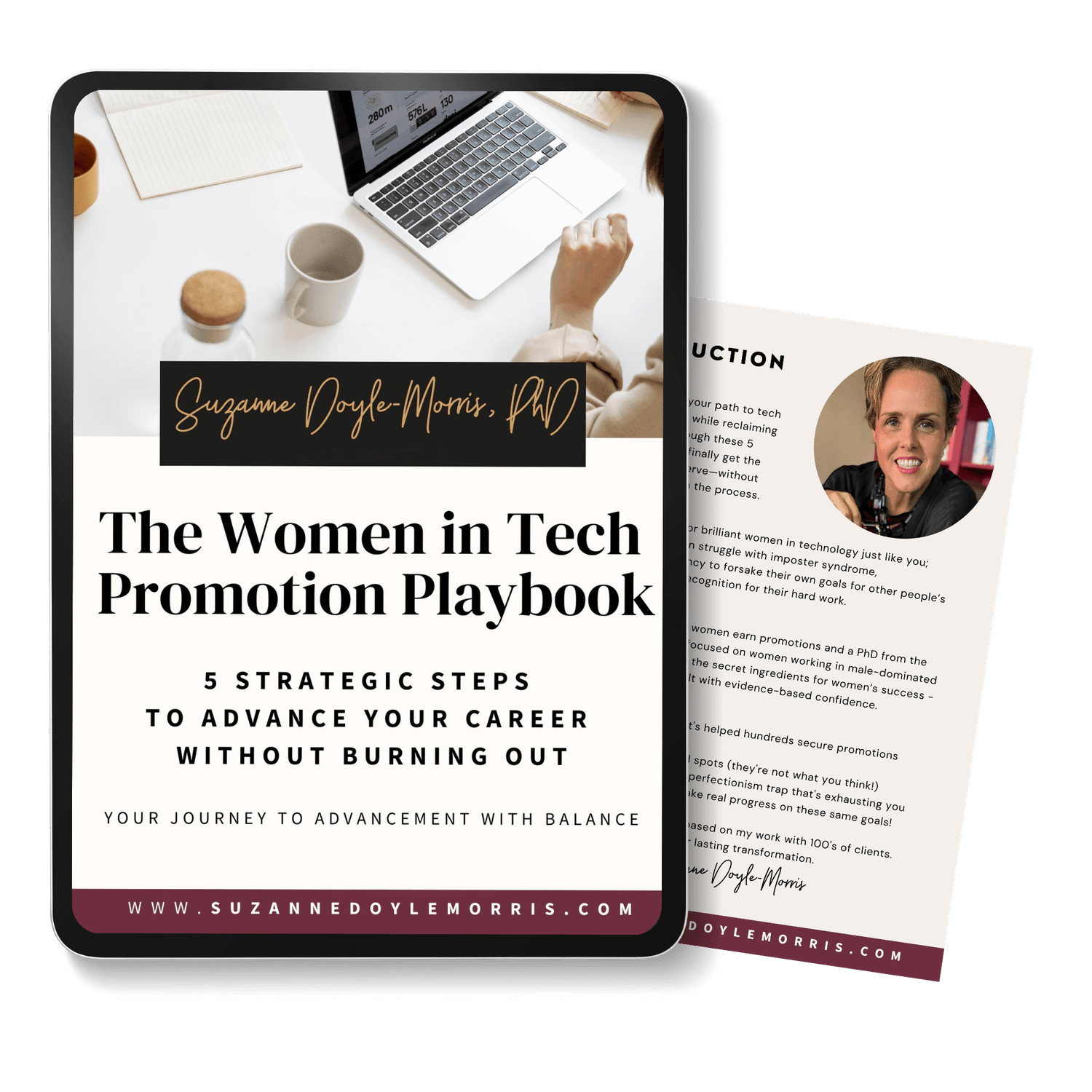
Your roadmap to advancement with balance.
The Women in Tech Promotion Playbook is a practical, evidence-based guide.
It's designed solely for ambitious women in STEM who want to advance their careers without burning out.
Drawing on over 25 years of coaching, research and consultancy, I outline five strategic steps that help women move from being overworked and under-recognised to confident, visible leaders.
Latest on the blog
The Women in Tech Promotion Playbook
Your roadmap to advancement with balance
The Women in Tech Promotion Playbook is a practical, evidence-based guide designed for ambitious women in STEM who want to advance their careers without burning out. Drawing on over 25 years of coaching and research, I outline five strategic steps that help women move from being overworked and under recognised to confident, visible leaders.