
Working Mother Guilt When You're the Main Earner
The finding from my research that surprised me most
People often ask what surprised me most when I was researching Female Breadwinners.
It wasn't the money.
It was how differently men and women judge themselves as parents.
In my experience, fathers link being a 'good provider' with being a 'good father.'
It was automatic for them.
Working late? Missed the school concert?
They knew he was working hard for the family.
Job done.
But when I was writing the book, the women I interviewed didn't make that link at all.
Paying for the life, and apologising about it
The women I interviewed were funding their families' lives.
And still they told me about the school events they'd missed and the days they couldn't be there.
As one put it, she was making the money for the family, but she desperately wished she could be at school events.
Because that's what she was judged on.
Her children might judge her.
Her in-laws often did.
Her parents did.
And, she admitted, she judged herself hardest of all.
Ouch.
Same job. Same hours.
Same missed concert.
Dads gave themselves a pass.
She gave herself a fail.
The 'decoupling' no one talks about
What I came to believe is that women need to pull these two ideas apart.
Being a good mother isn't measured only in hours at the school gate.
Providing for your family is part of caring for them.
Men have been allowed to count it for generations.
That doesn't mean the guilt simply switches off.
Kelly Willis Green, who interviewed me about the book on her Serious Coin podcast, made a point I liked.
Some of her clients, running successful businesses with supportive partners, still sometimes long to be the one provided for.
And they feel sheepish even admitting it.
Her view was that it's fine to notice the feeling.
It doesn't have to drive your decisions.
The weight of being 'the earner'
I heard another version of this from women who'd have loved to change direction.
Start their own company.
Move into the charity sector.
Do something that meant more to them.
But that would have cut the family's income dramatically, and their partner's earnings weren't going to fill the gap.
So they stayed.
The ones who seemed most at peace had partners who said, out loud, that if she wanted to earn less and do something more fulfilling, he'd back her.
Even if she never took him up on it, knowing the door was open made staying feel like a choice rather than a sentence.
Why it matters as you reach higher
If you're stepping up to a bigger role, the hours rarely shrink.
If every late meeting comes with a side order of guilt, you'll pay twice for the same promotion.
You may find it useful to read why high achievers blame themselves first and why senior women end up so exhausted.
So next time work keeps you from something at school, notice what you tell yourself.
Would you say it to a father in the same seat?
And if not, what would you say instead?
If you're weighing up a conversation like that, e-mail me at suzanne@doylemorris.com to arrange a chemistry call.
I write every fortnight about the things senior women in STEM often recognise but rarely say out loud.
Sign up on the front page of this website.
Welcome to my Blog

I'm Dr Suzanne Doyle‑Morris and I support professional women working in STEM.
Whether you’re seeking your next promotion, aiming for leadership, or simply looking to make your mark, this blog is created for you.
It's written for the ambitious woman in STEM ready to advance and succeed on her own terms.
Blog Categories
FREE GUIDE
The Women in Tech Promotion Playbook
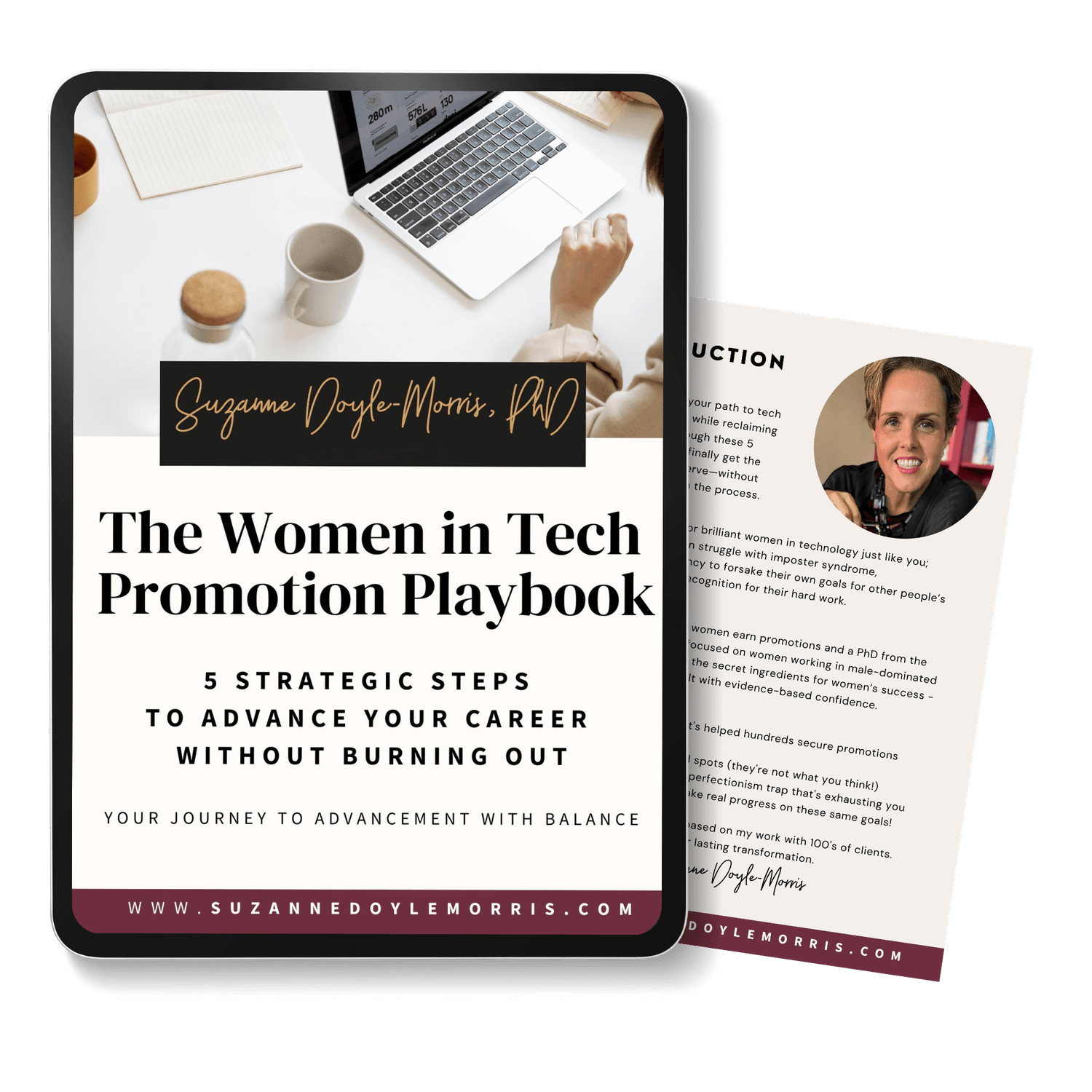
Your roadmap to advancement with balance.
The Women in Tech Promotion Playbook is a practical, evidence-based guide.
It's designed solely for ambitious women in STEM who want to advance their careers without burning out.
Drawing on over 25 years of coaching, research and consultancy, I outline five strategic steps that help women move from being overworked and under-recognised to confident, visible leaders.
Latest on the blog
The Women in Tech Promotion Playbook
Your roadmap to advancement with balance
The Women in Tech Promotion Playbook is a practical, evidence-based guide designed for ambitious women in STEM who want to advance their careers without burning out. Drawing on over 25 years of coaching and research, I outline five strategic steps that help women move from being overworked and under recognised to confident, visible leaders.