Why the Best Managers Drive Like It's a Manual Car
When the feedback comes back wearing a loaded word
A client of mine came to a session sitting uncomfortably with one word from ‘feedback’ that she couldn't get past.
A review had gathered feedback on her from her team; most neutral and some actually warm.
But one comment had lodged itself under her skin.
A few people on her team described her as ‘anxious’.
And that they felt her anxiety.
She is senior, technical, the kind of leader who carries the weight of the deadlines if her people don’t so readily.
And the word they reached for when describing her vibe was ‘anxious’.
But it landed as a small, precise wound.
Not loud and tough, but placed on shoulders that carried it.
The assumptions hiding inside the hurt
Her first instinct was sharp, and I think it was right.
A man running her team, carrying her load, would likely not have been called anxious.
He'd probably be described as ‘dedicated’ or ‘committed’ or even ‘driven by exacting standards’.
You know, someone who cares about getting it right.
Exactly like she did.
For her, in the largely male office, the word was gendered, and she knew it.
But there was a second thing sitting just behind the first, harder to look at.
She was the first to admit it, the truth is she does run hot when a deadline closes in.
Her team can feel the change in her.
So two ‘truths’ arrived in the same envelope.
One was unfair. And one had a kernel of truth.
The temptation for anyone, when you are feeling judged or threatened is to pick the comfortable truth and completely bin the other.
The reframe that changed how it felt
Nothing about the feedback changed; it had already been collected and been handed to the senior team.
After all, there was nothing she could do about that.
In our session, what changed was how she held it.
She stopped treating it as a verdict she had to either swallow whole or throw out whole.
The unfair label and the more productive truth could both be real at once and at the same time.
Naming that took the sting out.
It meant she no longer had to choose and explain to herself how they were wrong or blame herself for why they were right.
Powerfully, she found her own metaphor to describe what ‘good management’ actually means.
She reflected: ‘It's like driving a manual car. You have a clutch and you have the accelerator.
The skill isn't picking one forever. It's knowing, moment to moment, which to lead with.
'Some days the team needs the accelerator. A ‘let's go, let's make this brilliant, stay with it’ approach.
‘And some days they need the clutch. Steady, considered, no sudden pressure.’
Same driver. Same road. A different pedal, depending on what the moment asks.
She called it ‘selective authenticity’.
Not a mask, because nothing is hidden.
Just a choice about which true thing, both of which she had within her, to lead with.
The anxious label hadn't been a character flaw to apologise for. Nor was it something she needed to apologise for.
After all, if she’s carrying the can as the manager, she realised it was completely normal to get worked up about their deliverables!
Coming across as ‘anxious’ was one pedal, but perhaps pressed at the wrong moments.
Why this is so easy to get wrong from the inside
When feedback arrives wearing a loaded word, the instinct is to react to the whole of it at once.
Reject it as sexist, political or just plain ‘wrong’.
Or absorb it as proof something is wrong with you.
Both responses hand the feedback more power than it has actually earned.
The harder, truer move is to separate the unfair word from the real pattern underneath it.
"Too anxious." Or "Needing more executive presence." Or "Being a bit much."
Some of it is the shorthand a man would never hear, but are ‘descriptions’ the women with whom I work get handed routinely.
Some of it contains one small thing worth using.
She didn't leave with a mask, or with a way to be less herself.
She left knowing which pedal to lead with, and that the choice was hers.
Want the deeper version of this?
My free Women in Tech Promotion Playbook walks through exactly how senior women get past feeling judged.
How they position themselves with the people who decide promotions, and stop waiting to be noticed for work that should speak for itself.
Welcome to my Blog

I'm Dr Suzanne Doyle‑Morris and I support professional women working in STEM.
Whether you’re seeking your next promotion, aiming for leadership, or simply looking to make your mark, this blog is created for you.
It's written for the ambitious woman in STEM ready to advance and succeed on her own terms.
Blog Categories
FREE GUIDE
The Women in Tech Promotion Playbook
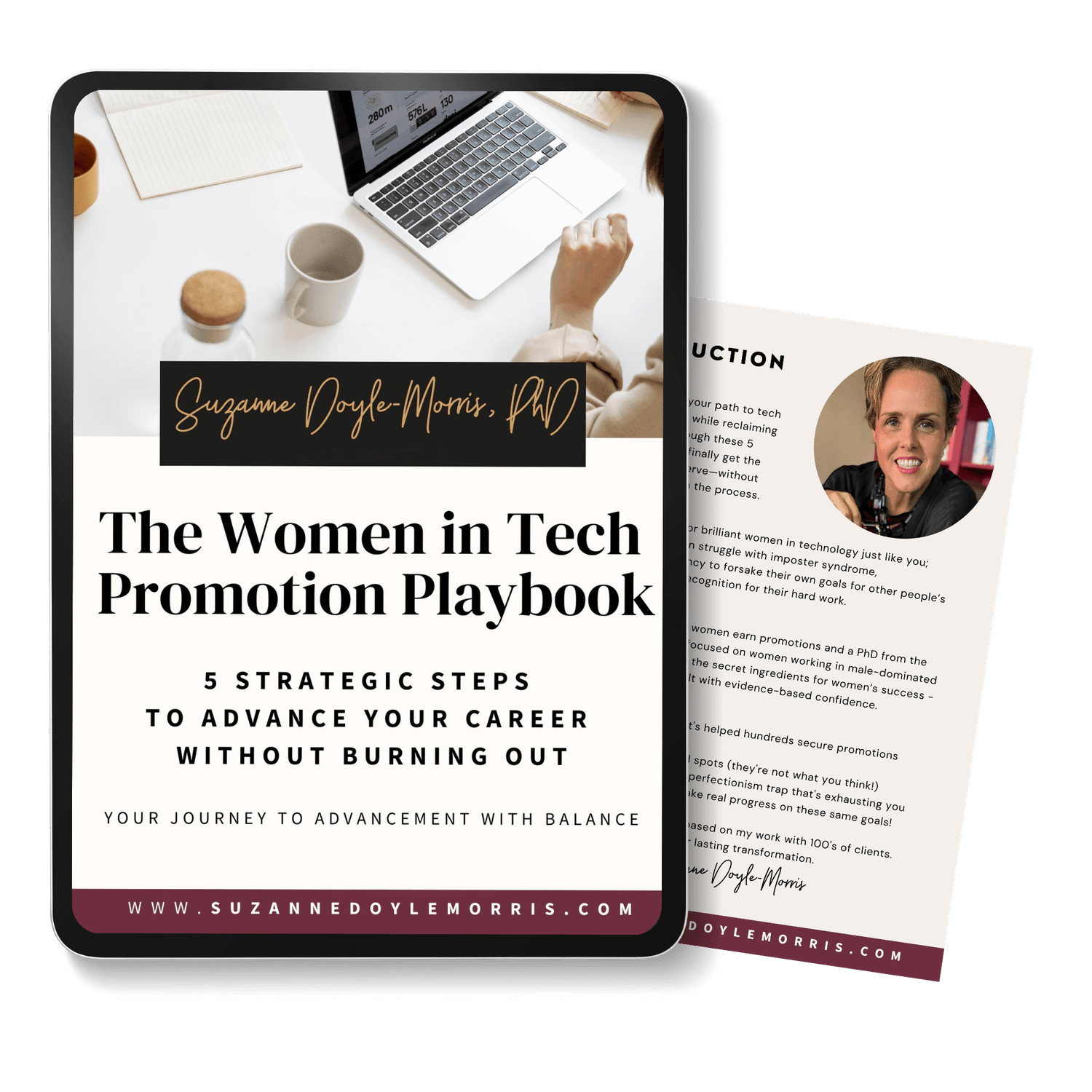
Your roadmap to advancement with balance.
The Women in Tech Promotion Playbook is a practical, evidence-based guide.
It's designed solely for ambitious women in STEM who want to advance their careers without burning out.
Drawing on over 25 years of coaching, research and consultancy, I outline five strategic steps that help women move from being overworked and under-recognised to confident, visible leaders.
Latest on the blog
The Women in Tech Promotion Playbook
Your roadmap to advancement with balance
The Women in Tech Promotion Playbook is a practical, evidence-based guide designed for ambitious women in STEM who want to advance their careers without burning out. Drawing on over 25 years of coaching and research, I outline five strategic steps that help women move from being overworked and under recognised to confident, visible leaders.