Gender Diversity Strategy in Global Law Firm
The Challenge: Losing Women at Every Career Stage
A London-based international law firm with over 2,500 employees globally recognized they were losing mid-career women at an alarming rate. The drop-off was particularly dramatic at Partner level—frustrating given that 60% of all trainee hires for over a decade had been young women.
Specific Challenges
The firm faced interconnected obstacles that required comprehensive legal sector culture change:
Merger-driven culture erosion: 15 years of mergers and acquisitions had systematically reduced senior women at each stage, leaving the new firm with fewer female leaders than before each merger
Partnership pipeline failure: Despite a high level of female trainee intake, only 21% of Partners were women
"Always-on" culture: Expectations around availability and responsiveness that disadvantaged those with caring responsibilities
UK-centric leadership model: White, male, London-based leadership didn't reflect global expansion into Middle Eastern and Asian markets
Technology under-utilization: Failure to leverage technology for flexible working arrangements
Committee representation: Senior decision-making committees lacked gender diversity
Family-unfriendly practices: Policies and informal norms that made partnership incompatible with family responsibilities
Regional office marginalization: Offices outside London felt disconnected from leadership and career advancement opportunities
Competitive pressure: Other law firms beginning to address gender balance, creating risk of losing talent to competitors
The Goal: Partnership Parity and Inclusive Global Culture
The firm sought to increase the number of women at Partnership level while creating a more inclusive culture for a wider range of people, particularly those from offices outside London.
Leadership understood this wasn't just about fairness—it was about survival.
Expanding into Middle Eastern and Asian markets with a predominantly white, male, UK-centric leadership model was strategically untenable.
They needed their leadership to reflect both their talent pipeline and their growing client base.
Our Approach: Strategic Integration of Business and Diversity Goals
Dr. Suzanne Doyle-Morris worked with the firm on-site for six months to institute legal sector culture change at the highest levels.
She led the Board, Senior Partners, and Managing Partner in discussions on aligning wider business goals with their new wider focus on diversity.
This ensured this wasn't treated as a separate initiative but as core business strategy or a way to simply 'fix the women.'
Comprehensive Assessment Methodology
The diversity and inclusion strategy included:
Leadership alignment sessions: Working with Board and Senior Partners to connect diversity goals to business strategy
Stakeholder interviews: 70 staff members across focus groups and individual meetings
Sector and service head consultations: Understanding specific challenges in different practice areas
Merger impact analysis: Examining the long-term cultural effects of each merger and acquisition on their employees
Client-facing events: Public engagement on how the culture was changing, building external accountability
Regional office inclusion: Ensuring perspectives from offices outside London informed recommendations
The high-profile nature of Dr. Doyle-Morris' work sent a clear signal: women at the firm were pleased to see gender balance being addressed seriously, giving them optimism about their own futures.
The Results: From Problem Firm to Award-Winning Leader
Externally, the firm transformed from one with significant gender balance problems to one seen as leading on these issues in the legal sector—even winning awards for their diversity initiatives.
Measurable Leadership Changes (Three Years Post-Engagement)
Promotion processes inadvertently favored those who fit the traditional military-trained profile
Women and diverse candidates were being overlooked despite statistically stronger performance than their competitors
Succession planning lacked intentional diversity considerations
HR processes needed evolution with a diversity and inclusion lens
High-potential women lacked structured development opportunities
Many initially dubious employees would support change if leadership demonstrated genuine commitment
The facilitation process helped enable a realistic action plan with clear accountabilities and review periods—essential for an organization accustomed to precision and measurable standards.
The firm achieved dramatic increases in female representation across leadership:
Remuneration Committee: 50% (from significantly lower baseline)
Board Level: 38% (substantial increase)
Partnership Nominations Committee: 50% (ensuring diverse pipeline consideration)
Service Heads: 33% (leadership across practice areas)
Partnership Promotion Success
In a subsequent round of promotions following the implementation:
Women comprised 38% of all new Partners
This represented nearly double the 21% baseline prior to engaging Dr. Doyle-Morris
Demonstrated sustainable pipeline development, not just one-time adjustment
Cultural Transformation
Beyond the numbers, the engagement created:
Internal optimism: Women at the firm gained confidence in their career prospects
External reputation shift: From laggard to leader on gender diversity in legal sector
Client engagement: Public discussions about culture change created client confidence
Award recognition: Industry acknowledgment of diversity progress
Competitive positioning: Shifted from talent risk to talent magnet
Sustained Commitment
The firm understood there were no silver bullets on this issue. Leadership recognized they would have to remain focused just to keep pace with competitors, let alone better their own efforts—a realistic perspective that has enabled continued progress beyond the initial engagement.
About Dr. Suzanne Doyle-Morris
Dr. Suzanne Doyle-Morris is an ICF Master Certified Coach (MCC) with a PhD from the University of Cambridge focusing on women in Engineering.
For 25 years, she's coached accomplished women in STEM as they advance to senior leadership.
She's the author of three books: "Beyond the Boys' Club: Strategies for Achieving Career Success as a Woman Working in a Male Dominated Field," "The Con Job: Getting Ahead for Competence in a World Obsessed with Confidence," and "Female Breadwinners: How They Make Relationships Work and Why they are Future of the Modern Workforce."
80% of her clients secure promotions or stretch roles within 12 months.
Not because she gives advice, but because she asks the right questions.
Welcome to my Blog

I'm Dr Suzanne Doyle‑Morris and I support professional women working in STEM.
Whether you’re seeking your next promotion, aiming for leadership, or simply looking to make your mark, this blog is created for you.
It's written for the ambitious woman in STEM ready to advance and succeed on her own terms.
Blog Categories
FREE GUIDE
The Women in Tech Promotion Playbook
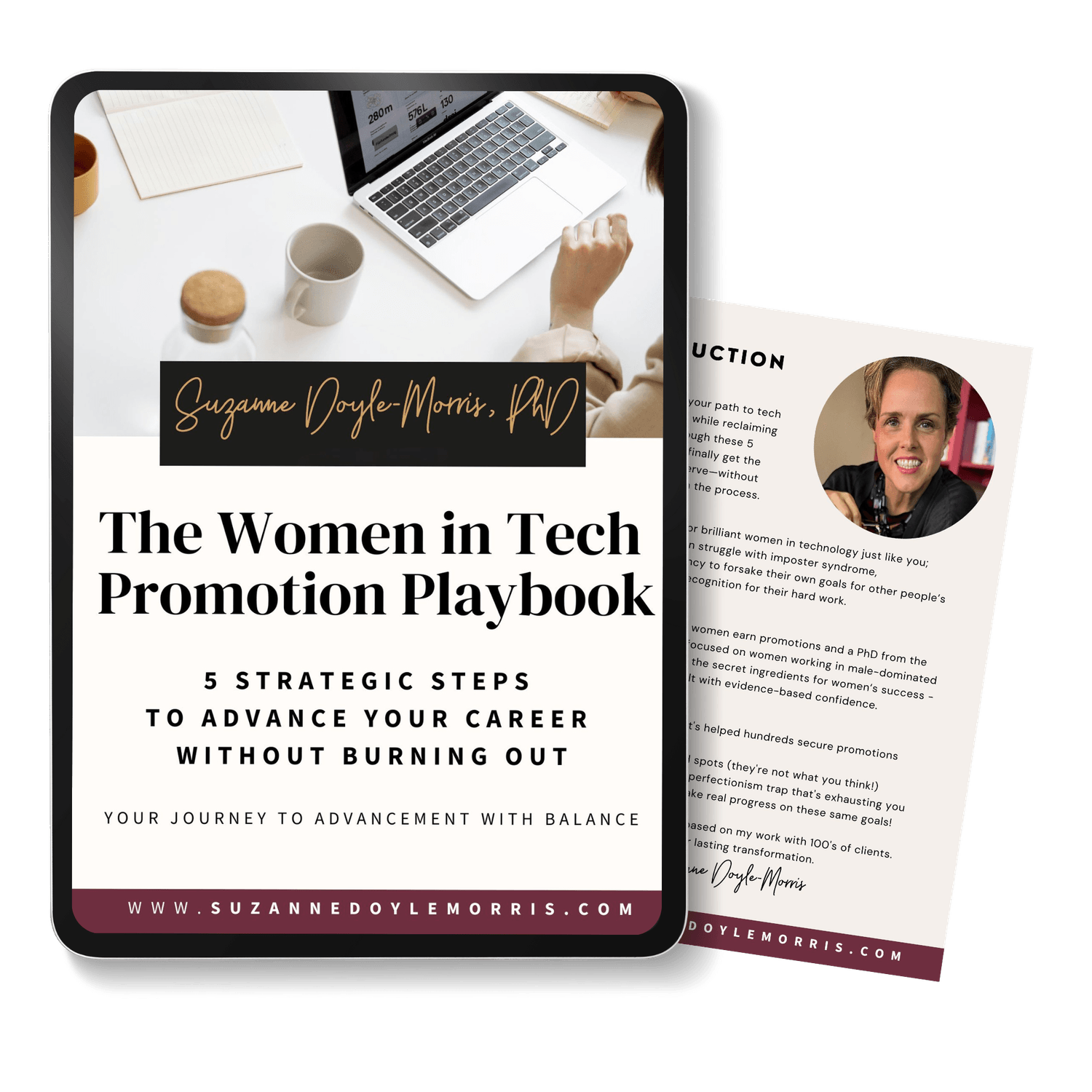
Your roadmap to advancement with balance.
The Women in Tech Promotion Playbook is a practical, evidence-based guide.
It's designed solely for ambitious women in STEM who want to advance their careers without burning out.
Drawing on over 25 years of coaching, research and consultancy, I outline five strategic steps that help women move from being overworked and under-recognised to confident, visible leaders.
Latest on the blog
The Women in Tech Promotion Playbook
Your roadmap to advancement with balance
The Women in Tech Promotion Playbook is a practical, evidence-based guide designed for ambitious women in STEM who want to advance their careers without burning out. Drawing on over 25 years of coaching and research, I outline five strategic steps that help women move from being overworked and under recognised to confident, visible leaders.


Free Workbook
The Senior Women in STEM Leadership Playbook
5 strategic steps to advance your STEM career — without burning out.
Ready to get recognised for the impact you already make? This free workbook gives ambitious women in technology a proven, evidence-based framework for earning promotions with confidence — while keeping balance and wellbeing intact.