Diversity & Inclusion Strategy in Global Spirits Company
The Challenge: Falling Behind in a Changing Market
A Scotland-based global distillery with operations across four continents recognised they were falling behind competitors in attracting, retaining, and developing female and leaders from BAME backgrounds.
The global market for their products was expanding—particularly amongst female drinkers—making it clear that 'business as usual' was no longer feasible.
Specific Challenges
The company faced interconnected obstacles to implementing an effective diversity and inclusion strategy:
Limited diversity in leadership: Few women and employees from BAME backgrounds in senior positions
Misaligned market strategy: Sending UK expats to diverse international markets they didn't fully understand or reflect
Succession planning gaps: Traditional promotion practices that looked only at "the usual suspects"
Board buy-in needed: Family-owned business requiring compelling business case for change
Cultural resistance: Traditional norms in the spirits sector working against inclusive practices
Talent pipeline issues: Losing competitive advantage in attracting talent from growing consumer demographics
Global complexity: Needed consistent approach across UK, North America, Europe, and Asia offices
The Goal: Building Leadership That Reflects the Market
The company sought to develop a more diverse internal leadership team that would look beyond traditional candidates when considering promotions.
Working with their first-ever female CEO, they recognised the need to stop sending expats to markets with whom they didn't identify.
Instead, they wanted to develop local talent and create an inclusive mindset more widely throughout the organisation.
The CEO was determined to better engage both women and people from ethnically under-represented backgrounds—not just because it was the right thing to do, but because the business case was undeniable.
Our Approach: Global Culture Assessment
Dr. Suzanne Doyle-Morris worked directly with the company's first female CEO on drafting all internal messaging to gain support from both employees and the Board.
She conducted comprehensive interviews and focus groups with employees across their global operations.
Assessment Scope
The diversity and inclusion strategy assessment included:
Current employees across UK, North America, Europe, and Asia offices
Expatriate employees who had moved from UK headquarters to regional offices
UK hiring leaders responsible for talent decisions
Recent departures: Sample of employees who had left in the previous six months to understand retention issues
This multi-stakeholder approach ensured Dr. Doyle-Morris captured perspectives from those experiencing the culture, those shaping it, and those who had chosen to leave it.
What the Assessment Revealed
After four months of research, Dr. Doyle-Morris' report uncovered critical findings that many in leadership—even the initially dubious—found impossible to ignore:
Key discoveries:
Alarmingly few women and UK BAME employees were being actively considered for senior roles
Even fewer were being prepared or developed for advancement
Local talent in regional markets was being overlooked in favour of UK expats
Succession planning processes inadvertently perpetuated homogeneous leadership
The disconnect between customer demographics and internal leadership was widening
The report provided 22 specific recommendations with a practical timetable for implementation, giving the UK senior leadership team the roadmap they needed to drive culture change in FMCG amidst traditional industry norms.
The Results: Doubling Down on Diversity Delivers Business Growth
The report, recommendations, and presentation helped the CEO build the compelling business case she had been determined to bring to the family-owned board's attention.
Implementation Success
Most of the 22 recommendations were adopted over the following two years.
The most significant was implementing a robust succession planning model that actively identified and prepared diverse candidates for senior roles.
The CEO championed these changes throughout the organisation.
Under her leadership and with the diversity and inclusion strategy now embedded:
Turnover nearly doubled in the year following Dr. Doyle-Morris' involvement
Pre-tax profits increased by 50% in the same period
Leadership diversity improved with more women and BAME employees in senior positions
Regional offices strengthened through developing local talent rather than relying on expats
Talent attraction improved as the company's reputation for inclusion grew
The assignment demonstrated to even the most sceptical that creating an inclusive culture wasn't just morally right—it was essential for business success in a changing global market.
About Dr. Suzanne Doyle-Morris
Dr. Suzanne Doyle-Morris is an ICF Master Certified Coach (MCC) with a PhD from the University of Cambridge focusing on women in Engineering.
For 25 years, she's coached accomplished women in STEM as they advance to senior leadership.
She's the author of three books: "Beyond the Boys' Club: Strategies for Achieving Career Success as a Woman Working in a Male Dominated Field," "The Con Job: Getting Ahead for Competence in a World Obsessed with Confidence," and "Female Breadwinners: How They Make Relationships Work and Why they are Future of the Modern Workforce."
80% of her clients secure promotions or stretch roles within 12 months.
Not because she gives advice, but because she asks the right questions.
Welcome to my Blog

I'm Dr Suzanne Doyle‑Morris and I support professional women working in STEM.
Whether you’re seeking your next promotion, aiming for leadership, or simply looking to make your mark, this blog is created for you.
It's written for the ambitious woman in STEM ready to advance and succeed on her own terms.
Blog Categories
FREE GUIDE
The Women in Tech Promotion Playbook
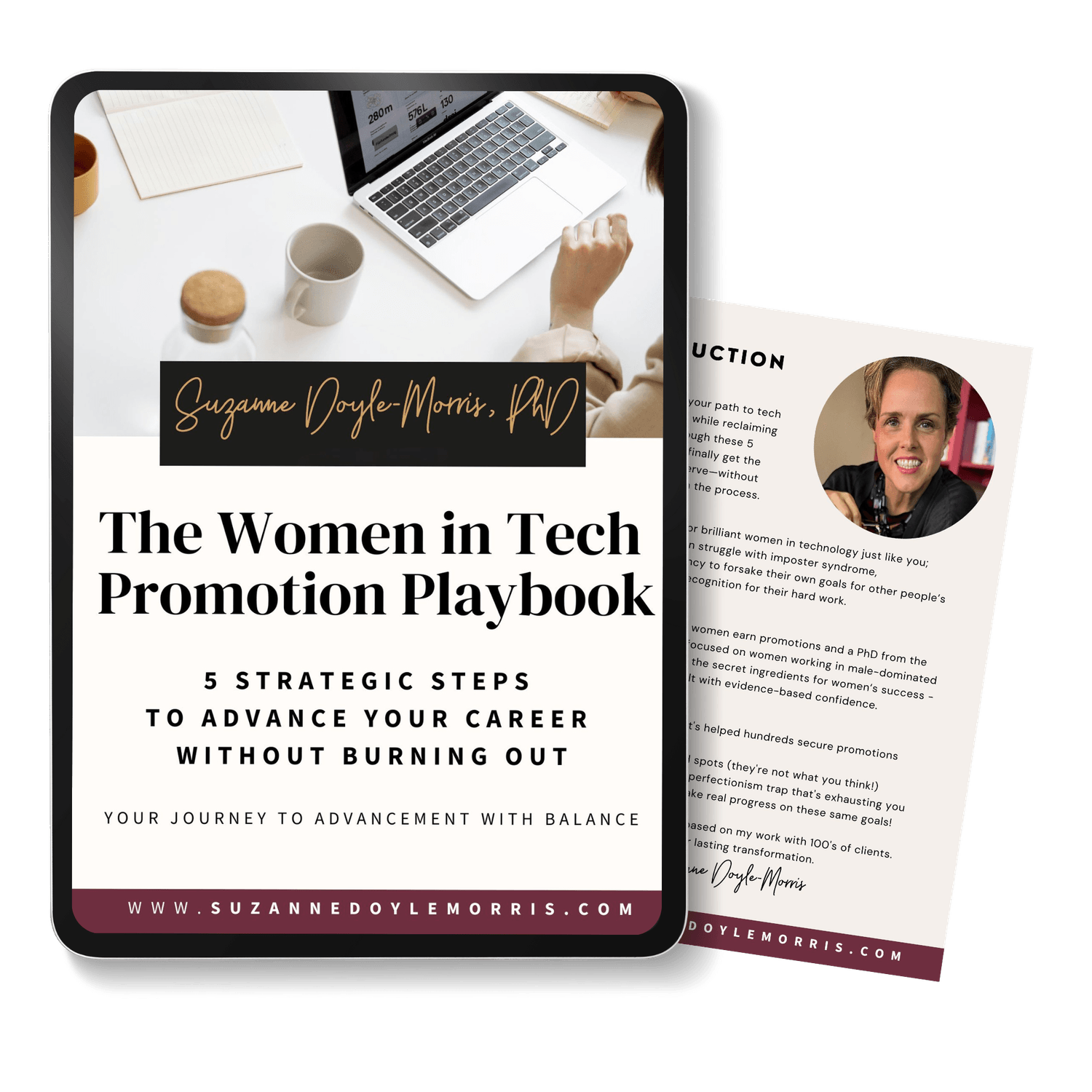
Your roadmap to advancement with balance.
The Women in Tech Promotion Playbook is a practical, evidence-based guide.
It's designed solely for ambitious women in STEM who want to advance their careers without burning out.
Drawing on over 25 years of coaching, research and consultancy, I outline five strategic steps that help women move from being overworked and under-recognised to confident, visible leaders.
Latest on the blog
The Women in Tech Promotion Playbook
Your roadmap to advancement with balance
The Women in Tech Promotion Playbook is a practical, evidence-based guide designed for ambitious women in STEM who want to advance their careers without burning out. Drawing on over 25 years of coaching and research, I outline five strategic steps that help women move from being overworked and under recognised to confident, visible leaders.


Free Workbook
The Senior Women in STEM Leadership Playbook
5 strategic steps to advance your STEM career — without burning out.
Ready to get recognised for the impact you already make? This free workbook gives ambitious women in technology a proven, evidence-based framework for earning promotions with confidence — while keeping balance and wellbeing intact.