Culture Change & Diversity Strategy in Aviation
The Challenge: Breaking Through a Long-Service Military Culture
A UK aviation organization recognized they needed to improve how they attracted, retained, and developed diverse talent to strengthen succession planning.
New leadership understood there was a systemic issue with inclusion and a need for culture change within aviation more broadly.
Specific Challenges
The organization faced deeply embedded obstacles to creating an inclusive culture:
Long-service military culture: Many employees were military recruits with limited alternative career options after air traffic control training
Homogeneous leadership pipeline: Succession planning processes inadvertently perpetuated similar demographics and nepotism
Cultural entrenchment: Established ways of working resistant to evolution
Gender pay gap reporting pressure: Legal imperative mounting with new reporting requirements
Site-specific focus: Initial work concentrated on one location, with hopes to scale insights to other sites
Sub-cultures within operations: Different teams and departments had developed distinct micro-cultures
Skepticism about change: Long-tenured employees dubious about diversity and inclusion initiatives
Lack of diverse role models: Few women in senior positions to demonstrate viable career paths
The Goal: Systematic Culture Change Through Evidence
The organization sought to fundamentally improve their culture and transform their promotion and succession planning processes.
They wanted evidence-based recommendations that would drive genuine inclusion and diversity improvements—not superficial changes that would fade once attention moved elsewhere.
Leadership recognized that creating culture change in aviation required understanding not just the formal policies, but the lived experience of employees navigating the organization's distinct environment and sub-cultures.
Our Approach: Immersive On-Site Assessment
Dr. Suzanne Doyle-Morris worked with the organization for four months, conducting a comprehensive culture assessment.
Unlike remote consultancy work, she was based on-site to fully understand the employer's people, operations, challenges, environment, and the various cultures and sub-cultures that had developed over decades of operation.
Assessment Methodology
The diversity and inclusion strategy assessment included:
Extended on-site presence: Observing day-to-day operations and interactions
Individual interviews: Conversations with employees at all levels
Leadership engagement: Working directly with the Senior Leadership Team
Operational immersion: Understanding the technical demands and safety culture unique to air traffic control
Sub-culture analysis: Identifying how different teams and departments operated
Process review: Examining HR systems, promotion criteria, and succession planning
Facilitated reflection: Helping the Senior Leadership Team acknowledge challenges they had normalized
What the Assessment Revealed
After a year of assessment, Dr. Doyle-Morris presented 15 key recommendations for enabling positive change with tangible actions.
The comprehensive report provided the Senior Leadership Team with evidence that prompted genuine reflection and discussion about the need for culture change within the aviation services they provided.
Critical discoveries:
Promotion processes inadvertently favored those who fit the traditional military-trained profile
Women and diverse candidates were being overlooked despite statistically stronger performance than their competitors
Succession planning lacked intentional diversity considerations
HR processes needed evolution with a diversity and inclusion lens
High-potential women lacked structured development opportunities
Many initially dubious employees would support change if leadership demonstrated genuine commitment
The facilitation process helped enable a realistic action plan with clear accountabilities and review periods—essential for an organization accustomed to precision and measurable standards.
The Results: Sustained Change Over Three Years
At a time when the legal imperative was mounting due to gender pay reporting, Dr. Doyle-Morris enabled a platform for issues and challenges to be shared, acknowledged, and most importantly, acted upon.
Implementation Success
All 15 recommendations were agreed by the Senior Leadership Team. Most were initially considered "stretches"—ambitious targets that seemed difficult to achieve. Instead, they became a comprehensive programme of change rolled out over three years for sustainability.
Key outcomes:
Executive Coaching Programme:
5 high-potential women received executive coaching (delivered via live and virtual sessions as the COVID pandemic hit)
80% of those receiving coaching earned a more senior role within 8 months
Success led to a doubling of the programme with another mixed-gender cohort
Coaching focused on helping women progress and sustain advancement into senior roles
Organizational Culture Shifts:
Wider recognition amongst initially dubious employees that inclusion was now a genuine corporate value, not just rhetoric
Having Dr. Doyle-Morris publicly on-site highlighted the Senior Leadership Team's commitment to take ownership and make change happen on diversity and inclusion
Permission granted to explore wider HR processes with a diversity and inclusion lens
Evolution implemented where it was long overdue
Strategic Positioning
Other business areas became interested as discussions about diversity and inclusion grew
The local site gained greater influence in corporate initiatives, capitalizing on having already started the work
This broader engagement was considered a significant win for the client
The CEO reported: "The individuals and the organization benefitted hugely from partnering with Dr. Suzanne Doyle-Morris. She provided much valued D&I expert advice and support when the business, legal and social imperative for creating an inclusive workforce have never been clearer."
The three-year implementation timeline demonstrated that sustainable culture change in aviation requires both immediate actions and long-term commitment—a balance Dr. Doyle-Morris helped the organization navigate successfully.
About Dr. Suzanne Doyle-Morris
Dr. Suzanne Doyle-Morris is an ICF Master Certified Coach (MCC) with a PhD from the University of Cambridge focusing on women in Engineering.
For 25 years, she's coached accomplished women in STEM as they advance to senior leadership.
She's the author of three books: "Beyond the Boys' Club: Strategies for Achieving Career Success as a Woman Working in a Male Dominated Field," "The Con Job: Getting Ahead for Competence in a World Obsessed with Confidence," and "Female Breadwinners: How They Make Relationships Work and Why they are Future of the Modern Workforce."
80% of her clients secure promotions or stretch roles within 12 months.
Not because she gives advice, but because she asks the right questions.
Welcome to my Blog

I'm Dr Suzanne Doyle‑Morris and I support professional women working in STEM.
Whether you’re seeking your next promotion, aiming for leadership, or simply looking to make your mark, this blog is created for you.
It's written for the ambitious woman in STEM ready to advance and succeed on her own terms.
Blog Categories
FREE GUIDE
The Women in Tech Promotion Playbook
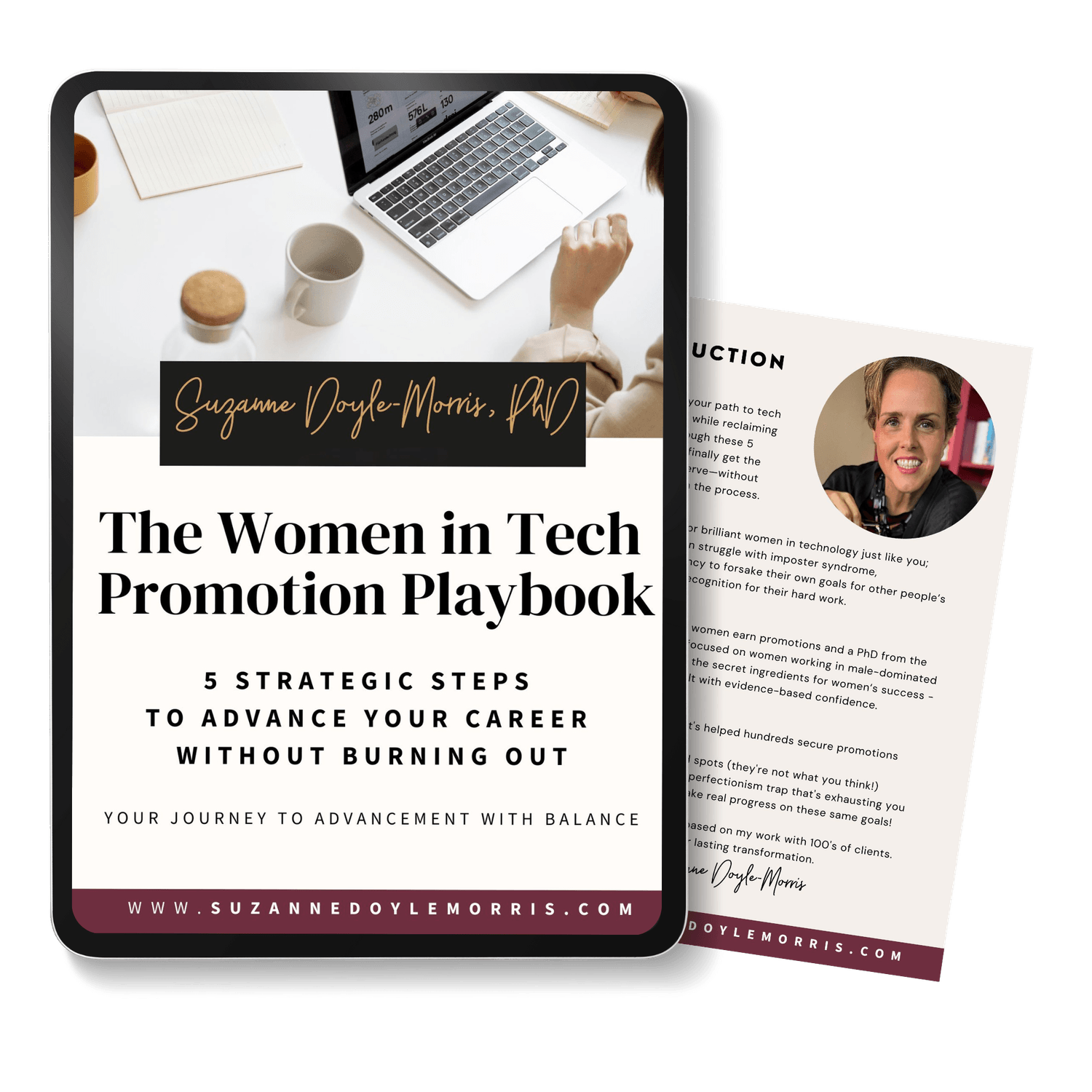
Your roadmap to advancement with balance.
The Women in Tech Promotion Playbook is a practical, evidence-based guide.
It's designed solely for ambitious women in STEM who want to advance their careers without burning out.
Drawing on over 25 years of coaching, research and consultancy, I outline five strategic steps that help women move from being overworked and under-recognised to confident, visible leaders.
Latest on the blog
The Women in Tech Promotion Playbook
Your roadmap to advancement with balance
The Women in Tech Promotion Playbook is a practical, evidence-based guide designed for ambitious women in STEM who want to advance their careers without burning out. Drawing on over 25 years of coaching and research, I outline five strategic steps that help women move from being overworked and under recognised to confident, visible leaders.


Free Workbook
The Senior Women in STEM Leadership Playbook
5 strategic steps to advance your STEM career — without burning out.
Ready to get recognised for the impact you already make? This free workbook gives ambitious women in technology a proven, evidence-based framework for earning promotions with confidence — while keeping balance and wellbeing intact.