
The Senior Leader's Secret: Why Your Inner Critic Gets Louder as You Succeed
The Hard Truth Nobody Mentions at Award Ceremonies
Roberta had finally "made it."
Senior position. Public recognition. Respected in her field.
So why did her inner critic sometimes feel louder than ever?
"I just want to get my mojo back,"
she joked during our Peak Resilience Accelerator programme.
The other women in the group smiled knowingly.
They all felt it too.
Here's the hard truth we don't discuss: sometimes success amplifies self-doubt rather than silencing it.
Why Your Inner Critic Gets Louder as You Climb
Roberta's now in a very senior position.
Her title proves she's "made it" among female leaders in STEM.
But that visibility made her more aware of critics.
Some external. Mostly internal.
As a woman in a male-dominated field, her minority status heightens everything.
Every comment from "the guys" lands harder - particularly as she knows the women below are looking to her as a model.
So real criticism stings.
Imagined criticism haunts.
And here's what surprised her most: the naïveté and accompanying confidence of her youth were gone.
Experience brought wisdom.
But it also brought awareness of all the ways things could go wrong.
Sound familiar?
The Myth That's Keeping You Stuck
Roberta didn't need a 'pep talk'.
She needed a different approach.
Mental fitness is about creating more robust neural pathways.
Pathways that help you shift faster from "This is overwhelming" to "What's the opportunity here?"
Here's how it works:
Every time you face a challenge, your brain can take two routes.
Route 1 (The Inner Critic Highway): "I can't do this. Everyone will see I'm not qualified. I'll fail spectacularly."
Route 2 (The Resilience Pathway): "This feels hard. But I've faced hard things before. What can I use from what I've already learned here?"
The more you use Route 2, the faster and more automatic it becomes.
The Questions That Build Mental Fitness
For Roberta, strengthening that resilience pathway meant reminding herself of past challenges she'd overcome.
Initially, those challenges seemed overwhelming.
But she's now successfully on the other side of them.
Reflecting on that?
That's where confidence comes from for women leaders.
Try this mental fitness exercise:
Look back at a past hurdle:
When did I face a big challenge before?
How did I get through it?
What helped my confidence most while going through it?
Apply those lessons now:
What does my older, wiser self want to remind me now?
What opportunity might be hiding in this current challenge?
What will I learn here that I can use in the future?
New hurdles always seem huge in the moment.
But when we look back, we got through them.
Even through discomfort, those experiences left valuable lessons.
Things to repeat. Things to avoid.
Why "Just Be Confident!" Advice Doesn't Work
You've probably heard: "Just be more confident! Lean in! Stop doubting yourself!"
That advice ignores reality.
Your inner critic isn't stupid.
It's trying to protect you from failure and criticism.
The goal isn't to silence it completely.
The goal is to acknowledge it and choose a different neural pathway.
"Thanks, Inner Critic. I hear your concern. Now let me remind you of three times I've handled similar challenges before."
The Beautiful Paradox of Senior Leadership
Here's what Roberta discovered through our work together:
Her inner critic got louder because she cared more.
She cared about doing great work.
She cared about the women following behind her.
She cared about representing her specialism well.
That caring created pressure.
And pressure amplifies doubt.
But that same caring also fueled her resilience.
When she remembered why her work mattered, the inner critic's volume naturally decreased.
Your Turn: Build Your Mental Fitness Muscles
Mental fitness isn't about eliminating self-doubt.
It's about building faster pathways to resilience.
The next time your inner critic pipes up, try this:
Acknowledge it: "I hear you, Inner Critic. You're worried about X."
Remind yourself of past success: "Remember when I faced Y? I got through it."
Ask the resilience question: "What's the opportunity in this challenge?"
The more you practice this pattern, the faster your brain makes that shift automatically.
Where Roberta Is Now
Several months into the Peak Resilience Accelerator programme, Roberta reported something interesting.
Her inner critic hadn't disappeared.
But it had quieted significantly.
More importantly?
She'd stopped expecting it to disappear completely.
She'd made peace with self-doubt as part of being human.
And that acceptance, paradoxically, reduced its power over her.
Want support building your own mental fitness muscles?
Email me at suzanne@doylemorris.com for a complimentary chemistry call.
We'll discuss your biggest workplace challenge and whether a 12-month coaching partnership makes sense for you.
Most of my clients are employer-funded!
Yes, your company will likely pay for this and I CAN help you get there.
About Dr. Suzanne Doyle-Morris
Dr. Suzanne Doyle-Morris is an ICF Master Certified Coach (MCC) with a PhD from the University of Cambridge focusing on women in Engineering.
For 25 years, she's coached accomplished women in STEM as they advance to senior leadership.
She's the author of three books: "Beyond the Boys' Club: Strategies for Achieve Career Success as a Woman Working in a Male Dominated Field," "The Con Job: Getting Ahead for Competence in a World Obsessed with Confidence," and "Female Breadwinners: How They Make Relationships Work and Why they are Future of the Modern Workforce."
80% of her clients secure promotions or stretch roles within 12 months.
Not because she gives advice, but because she asks the right questions.
Welcome to my Blog

I'm Dr Suzanne Doyle‑Morris and I support professional women working in STEM.
Whether you’re seeking your next promotion, aiming for leadership, or simply looking to make your mark, this blog is created for you.
It's written for the ambitious woman in STEM ready to advance and succeed on her own terms.
Blog Categories
FREE GUIDE
The Women in Tech Promotion Playbook
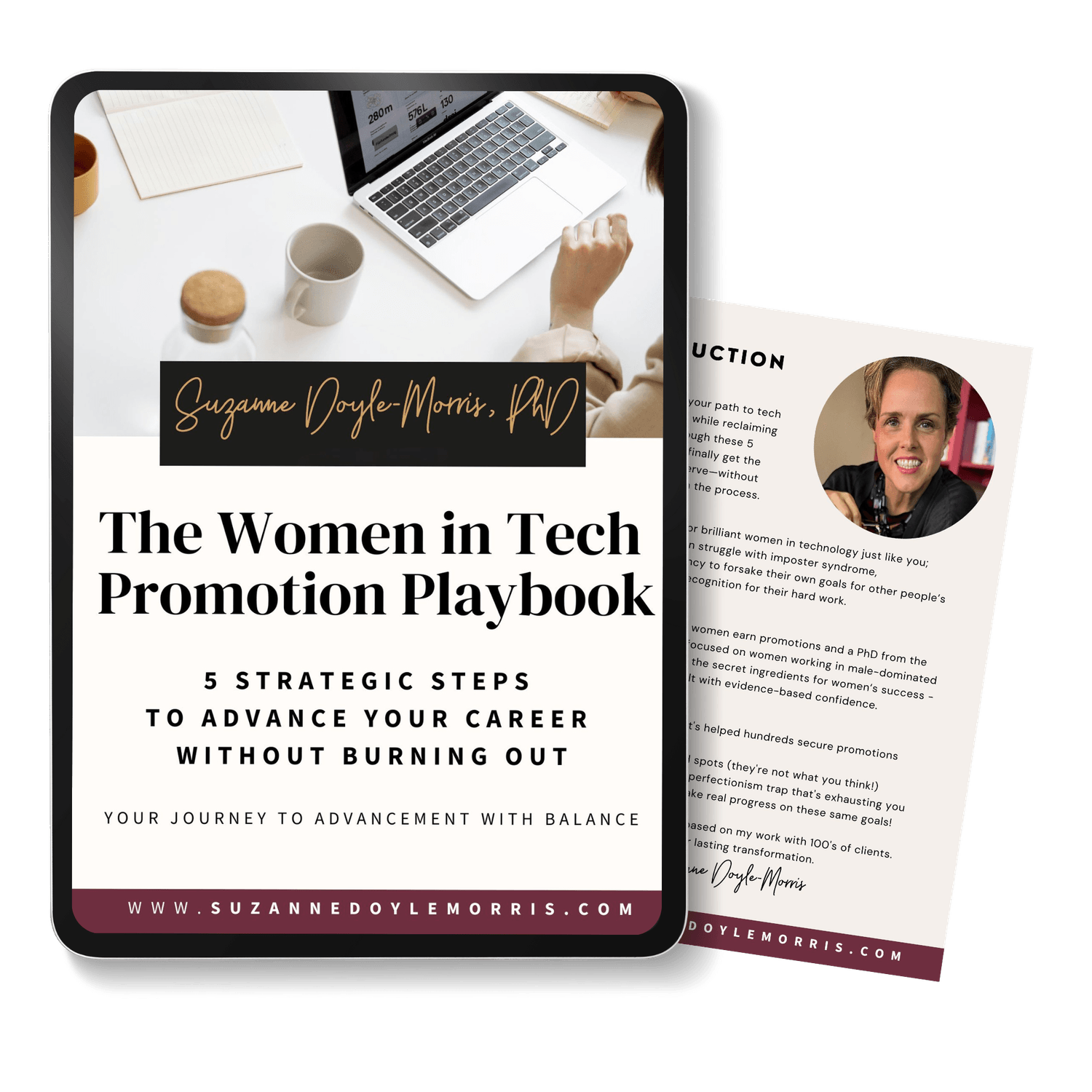
Your roadmap to advancement with balance.
The Women in Tech Promotion Playbook is a practical, evidence-based guide.
It's designed solely for ambitious women in STEM who want to advance their careers without burning out.
Drawing on over 25 years of coaching, research and consultancy, I outline five strategic steps that help women move from being overworked and under-recognised to confident, visible leaders.
Latest on the blog
The Women in Tech Promotion Playbook
Your roadmap to advancement with balance
The Women in Tech Promotion Playbook is a practical, evidence-based guide designed for ambitious women in STEM who want to advance their careers without burning out. Drawing on over 25 years of coaching and research, I outline five strategic steps that help women move from being overworked and under recognised to confident, visible leaders.


Free Workbook
The Senior Women in STEM Leadership Playbook
5 strategic steps to advance your STEM career — without burning out.
Ready to get recognised for the impact you already make? This free workbook gives ambitious women in technology a proven, evidence-based framework for earning promotions with confidence — while keeping balance and wellbeing intact.