She Thought Her Biggest Strength Was Running the Show
When Being Helpful Becomes a Problem
Ever notice how being helpful turns into resentment when it becomes expected?
Olivia rushed into our coaching session flustered.
She'd just spent two hours helping a colleague with a last-minute request.
Then she cancelled her theatre plans when her new boss asked to meet that evening. Again.
"I know I shouldn't have said yes," she told me.
"But everyone knows I'm helpful. It's my thing."
The Pattern Keeping Her Stuck
I asked: "What's the cost of that habit—tonight, and more broadly?"
She admitted she was annoyed.
Not just with others, but with herself.
Her biggest strength—being helpful—had become an unhelpful default.
That strength and reputation was running the show.
"They don't even ask anymore," she said.
"They just assume I'll do it."
Does this sound familiar?
The Reframe That Changed Everything
I offered a reframe: "What if your new boss is actually a gift?"
Olivia looked confused.
"He doesn't know your history yet," I observed. "Everyone else has learned you'll always accommodate them.
I continued: 'But he's new so he hasn't yet learned that. What if you could redefine this relationship from the start, on your terms?"
Her energy shifted.
For the first time, she saw an opportunity instead of another demand.
What She Did Next
The next time her boss suggested an evening meeting, Olivia said she wasn't available.
No elaborate excuse. No apology.
Just: "I'm not available that evening. Would Thursday afternoon work?"
He said yes immediately.
No pushback. No disappointment.
The breakthrough wasn't just about saying no.
It was recognizing that her accommodating pattern had trained people to expect instant availability.
Her new boss offered a chance to reset before those expectations formed.
The Result Six Months Later
Olivia stopped cancelling personal plans for work requests.
She negotiated realistic deadlines upfront instead of scrambling last-minute.
Her new boss respected her boundaries because she'd established them from day one.
Her team's performance improved.
When she stopped being constantly available, her team developed their own problem-solving skills.
They became more resourceful, not 'helpless'.
That's the paradox of professional boundaries.
Sometimes being less helpful makes you more effective.
Ready to Establish Stronger Boundaries?
Email me at suzanne@doylemorris.com for a complimentary chemistry call.
We'll explore your biggest challenge and whether a 12-month coaching partnership makes sense for you.
Most of my clients are employer-funded.
Yes, your company will likely pay for this and I can help you through that goal.
Learn more: www.suzannedoylemorris.com
About Dr. Suzanne Doyle-Morris
Dr. Suzanne Doyle-Morris is an ICF Master Certified Coach (MCC) with a PhD from the University of Cambridge focusing on women in Engineering.
For 25 years, she's coached accomplished women in STEM as they advance to senior leadership.
She's the author of three books: "Beyond the Boys' Club: Strategies for Achieving Career Success as a Woman Working in a Male Dominated Field," "The Con Job: Getting Ahead for Competence in a World Obsessed with Confidence," and "Female Breadwinners: How They Make Relationships Work and Why they are Future of the Modern Workforce."
80% of her clients secure promotions or stretch roles within 12 months.
Not because she gives advice, but because she asks the right questions.
Welcome to my Blog

I'm Dr Suzanne Doyle‑Morris and I support professional women working in STEM.
Whether you’re seeking your next promotion, aiming for leadership, or simply looking to make your mark, this blog is created for you.
It's written for the ambitious woman in STEM ready to advance and succeed on her own terms.
Blog Categories
FREE GUIDE
The Women in Tech Promotion Playbook
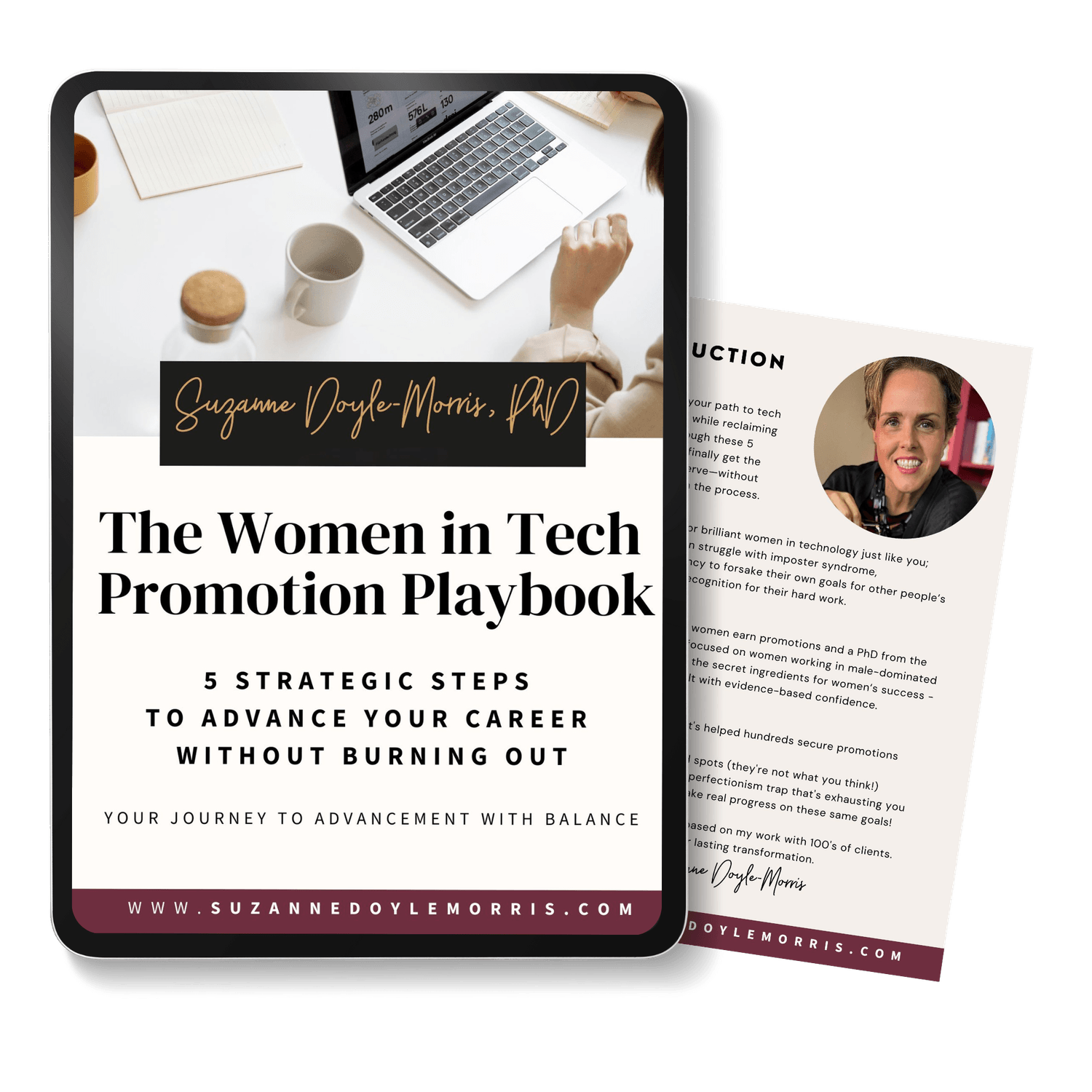
Your roadmap to advancement with balance.
The Women in Tech Promotion Playbook is a practical, evidence-based guide.
It's designed solely for ambitious women in STEM who want to advance their careers without burning out.
Drawing on over 25 years of coaching, research and consultancy, I outline five strategic steps that help women move from being overworked and under-recognised to confident, visible leaders.
Latest on the blog
The Women in Tech Promotion Playbook
Your roadmap to advancement with balance
The Women in Tech Promotion Playbook is a practical, evidence-based guide designed for ambitious women in STEM who want to advance their careers without burning out. Drawing on over 25 years of coaching and research, I outline five strategic steps that help women move from being overworked and under recognised to confident, visible leaders.


Free Workbook
The Senior Women in STEM Leadership Playbook
5 strategic steps to advance your STEM career — without burning out.
Ready to get recognised for the impact you already make? This free workbook gives ambitious women in technology a proven, evidence-based framework for earning promotions with confidence — while keeping balance and wellbeing intact.