
What Are You Saying No To By Saying Yes?
She Knew She Was Working Too Many Hours
Ranya's top saboteur was the "Pleaser."
She was motivated to make other people happy first, often at a cost to herself.
So learning to say no more often was a big goal for her in our coaching.
The Pleaser is common amongst my clients.
Women are often socialised into this role from a young age.
Keeping people happy serves them for a long time—until it doesn't.
At that point, the only person who's no longer happy is themselves.
Recognise this?
The Client Who Wasn't Worth It
Ranya talked with our Peak Resilience Accelerator group about a client requiring bespoke work.
She couldn't replicate the process with others.
The client wasn't even in her industry, so no loss-leading benefit.
As Ranya explained: "I mistakenly thought it was loss-leading work. But I can't do anything with it afterwards. It's just a loss."
She'd been working long hours, giving this low-paying client the same high standard she gave clients paying far more.
The Question That Shifted Everything
I observed: "You've served her well. But I also know you have other priorities for growing your business. By saying yes to her, what are you saying no to?"
Ranya immediately answered: "To all the other clients I haven't yet met! The ones I'm not getting to know or approaching because I'm so busy with her work!"
She paused. "I'm saying no to my normal workouts at the gym and socialising at weekends—all because I'm trying to finish this project off!"
The Permission She Needed
This realisation gave Ranya the "permission" and motivation to turn down work that wouldn't pay well enough.
This then freed up her time and mental energy for other more rewarding work.
Wanting this "permission to say no" is something I routinely hear from female clients—many of whom are 'Pleasers'.
By saying yes to low-paying work, what are you saying no to?
Ready to learn what you're actually saying no to and start saying yes to what matters?
Email me at suzanne@doylemorris.com for a complimentary chemistry call.
We'll explore your biggest challenge and whether a 12-month coaching partnership makes sense for you.
Most of my clients are employer-funded.
Yes, your company will likely pay for this and I can help you through that goal.
Learn more: www.suzannedoylemorris.com
About Dr. Suzanne Doyle-Morris
Dr. Suzanne Doyle-Morris is an ICF Master Certified Coach (MCC) with a PhD from the University of Cambridge focusing on women in Engineering.
For 25 years, she's coached accomplished women in STEM as they advance to senior leadership.
She's the author of three books: "Beyond the Boys' Club: Strategies for Achieving Career Success as a Woman Working in a Male Dominated Field," "The Con Job: Getting Ahead for Competence in a World Obsessed with Confidence," and "Female Breadwinners: How They Make Relationships Work and Why they are Future of the Modern Workforce."
80% of her clients secure promotions or stretch roles within 12 months.
Not because she gives advice, but because she asks the right questions.
Welcome to my Blog

I'm Dr Suzanne Doyle‑Morris and I support professional women working in STEM.
Whether you’re seeking your next promotion, aiming for leadership, or simply looking to make your mark, this blog is created for you.
It's written for the ambitious woman in STEM ready to advance and succeed on her own terms.
Blog Categories
FREE GUIDE
The Women in Tech Promotion Playbook
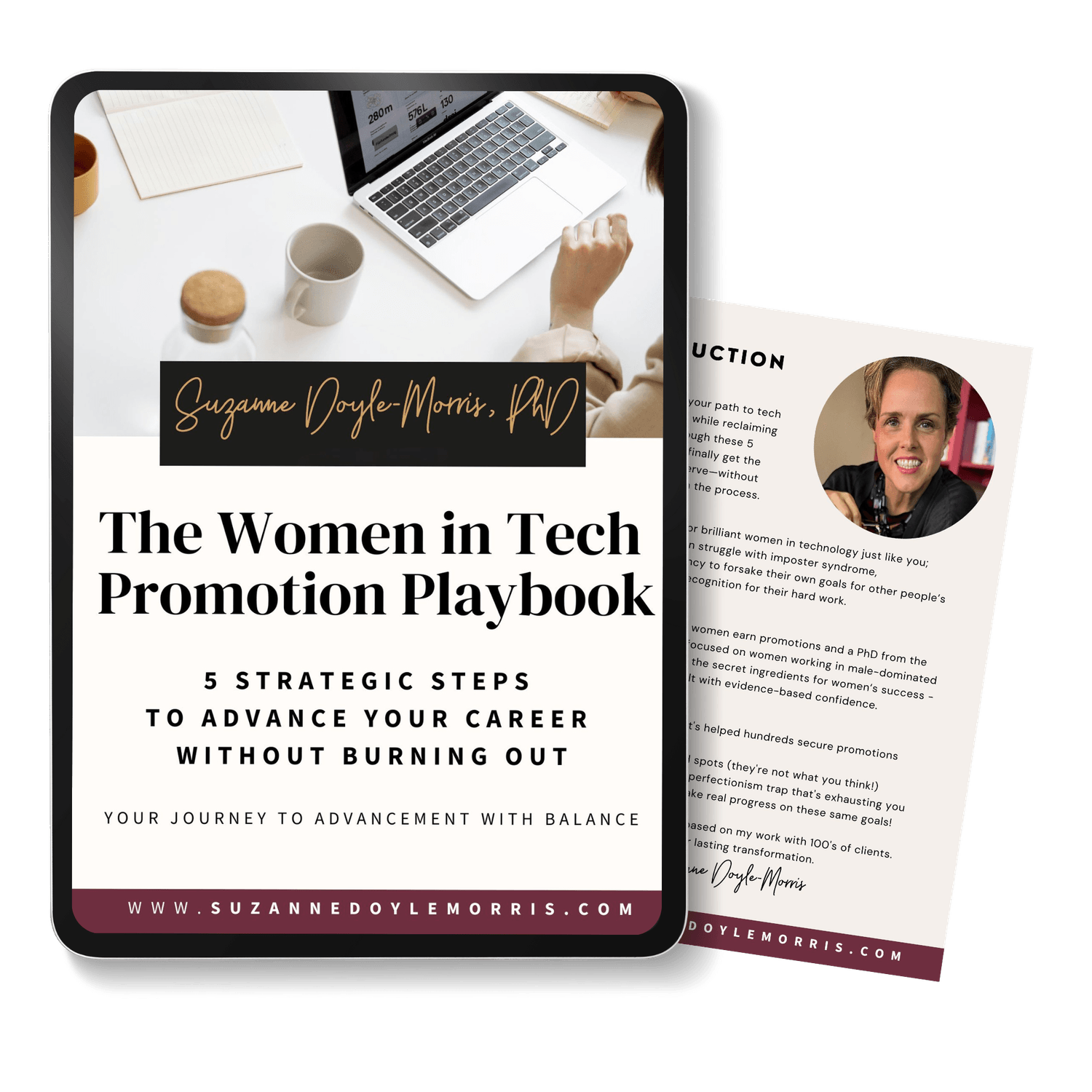
Your roadmap to advancement with balance.
The Women in Tech Promotion Playbook is a practical, evidence-based guide.
It's designed solely for ambitious women in STEM who want to advance their careers without burning out.
Drawing on over 25 years of coaching, research and consultancy, I outline five strategic steps that help women move from being overworked and under-recognised to confident, visible leaders.
Latest on the blog
The Women in Tech Promotion Playbook
Your roadmap to advancement with balance
The Women in Tech Promotion Playbook is a practical, evidence-based guide designed for ambitious women in STEM who want to advance their careers without burning out. Drawing on over 25 years of coaching and research, I outline five strategic steps that help women move from being overworked and under recognised to confident, visible leaders.


Free Workbook
The Senior Women in STEM Leadership Playbook
5 strategic steps to advance your STEM career — without burning out.
Ready to get recognised for the impact you already make? This free workbook gives ambitious women in technology a proven, evidence-based framework for earning promotions with confidence — while keeping balance and wellbeing intact.