How Your Future Self Solves Today's Workplace Challenge
One of the most powerful exercises in coaching is what I call 'time-travel.'
It's a way to view your current workplace challenges from a different point in your life—either looking back from your future self or forward from your younger self.
Clients tell me this tool stays with them far longer than our 12 months together.
They return years later saying it helped them through challenges I never even knew about.
Research suggests this more optimistic mindset could actually extend your longevity.
When you can view difficulties through the lens of time and perspective, they lose their power to consume your mental energy.
When Your Boss Is Your Biggest Challenge
Lauren came to coaching dealing with Tom, her narcissistic boss. He was routinely difficult, and his cutting comments occupied far too much of her headspace.
Every idea she proposed met with negativity. Every contribution felt diminished.
In one of our sessions, I asked: "Using the perspective we've discussed, what would your older, wiser self say about your situation with Tom?"
Her response was immediate: "If I can't influence or change it, I need to work around it.
That simple shift—working around Tom rather than trying to change him—kept her sane.
She stopped taking every 'no' as gospel. She found other people to support her ideas.
She remembered the self-empathy we'd been developing.
She laughed during one session: "My older wiser self reminds me most of this stuff doesn't matter.
And when I compare what I'm doing now with what my 18-year-old self thought I'd be able to do? I'm already knocking it out of the park!"
The Questions That Change Everything
If workplace challenges sound familiar, ask yourself:
How would your older, wiser self want you to look back at this situation?
What would your 18-year-old self say about all that you've accomplished so far?
These aren't just feel-good questions.
They're strategic reframing tools that help you see your current situation accurately rather than through the distorted lens of daily frustration.
Lauren used these questions to recognize her progress. She'd been making headway on projects Tom initially dismissed as not worthwhile.
As time progressed, Tom grudgingly acknowledged her ideas had merit.
He even started asking her opinion on things—something that hadn't happened in months before our coaching work.
From Headaches to Progress
During one of our later sessions, Lauren almost forgot to mention: "Oh, and I was the only one on my team to get the pay raise."
She paused, recognizing the significance: "Tom actually had to advocate for it. So maybe things aren't as terrible as they often feel."
She joked: "Some of my biggest headaches have been eradicated—plus I can actually work with Tom now!"
Why Time-Travel Works
This technique isn't about pretending problems don't exist. It's about seeing them accurately within the full context of your career and life.
Your 18-year-old self would be amazed at what you've accomplished.
Your future self knows that most of today's workplace challenges won't matter in five years.
Both perspectives are true—and both help you navigate difficult situations without letting them consume you.
When you can hold this dual perspective—honoring both the difficulty of your current challenge and the broader context of your life—you make better decisions.
You waste less energy on unchangeable situations.
You invest your effort where it actually creates movement.
The Longevity Connection
Research on positive psychology and optimism suggests that this kind of perspective-taking isn't just good for your career.
It may actually contribute to longer, healthier lives.
When you can view challenges through the lens of time—both backward and forward—you reduce the chronic stress that damages health.
You maintain the resilience that helps you bounce forward through difficulties rather than just surviving them.
Through our monthly coaching conversations, my clients discover their own versions of time-travel questions.
These emerge naturally from our discussions as we explore what's actually holding them back.
When you find your own insight through live conversation rather than reading generic advice, it sticks.
Your Turn
What would your older, wiser self say about your biggest workplace challenge right now?
What would your 18-year-old self think about all you've already accomplished?
These aren't rhetorical questions.
They're invitations to see your situation more accurately—and to make decisions from that clearer perspective.
Ready to explore your own time-travel perspective?
Email me at suzanne@doylemorris.com for a complimentary chemistry call.
We'll discuss your biggest workplace challenge and whether a 12-month coaching partnership makes sense for you.
Learn more: www.suzannedoylemorris.com
Welcome to my Blog

I'm Dr Suzanne Doyle‑Morris and I support professional women working in STEM.
Whether you’re seeking your next promotion, aiming for leadership, or simply looking to make your mark, this blog is created for you.
It's written for the ambitious woman in STEM ready to advance and succeed on her own terms.
Blog Categories
FREE GUIDE
The Women in Tech Promotion Playbook
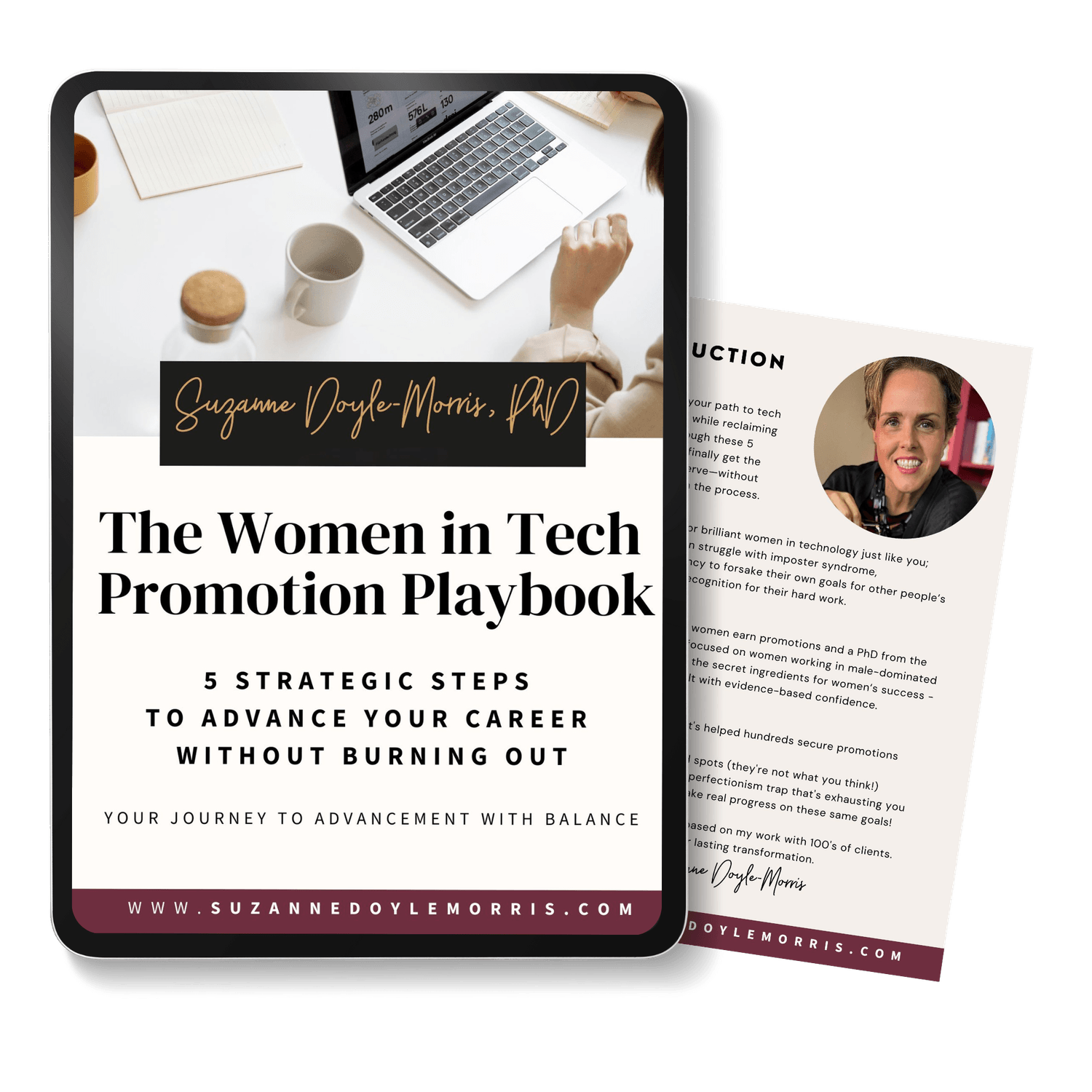
Your roadmap to advancement with balance.
The Women in Tech Promotion Playbook is a practical, evidence-based guide.
It's designed solely for ambitious women in STEM who want to advance their careers without burning out.
Drawing on over 25 years of coaching, research and consultancy, I outline five strategic steps that help women move from being overworked and under-recognised to confident, visible leaders.
Latest on the blog
The Women in Tech Promotion Playbook
Your roadmap to advancement with balance
The Women in Tech Promotion Playbook is a practical, evidence-based guide designed for ambitious women in STEM who want to advance their careers without burning out. Drawing on over 25 years of coaching and research, I outline five strategic steps that help women move from being overworked and under recognised to confident, visible leaders.


Free Workbook
The Senior Women in STEM Leadership Playbook
5 strategic steps to advance your STEM career — without burning out.
Ready to get recognised for the impact you already make? This free workbook gives ambitious women in technology a proven, evidence-based framework for earning promotions with confidence — while keeping balance and wellbeing intact.