When Hired for Being 'Different'—Then Punished for It
They Valued Your Voice—Until They Didn't
Penny wrote to me weeks after our final executive coaching session.
She was feeling "more confident and peaceful."
Confident, I expected.
But peaceful? That word struck me.
Penny had been hired as a Defence expert because of her "different" voice.
Her unique skills were in demand.
Then increasingly, they didn't value that voice.
She received positive appraisals from her direct reports and external stakeholders.
But low appraisals from male peers for being "difficult."
When discussing this, she retorted about her situation: "I can't be responsible if people are prejudiced against confident and competent middle-aged women."
Recognise this?
When Different Becomes a Liability
Despite our efforts, Penny discussed leaving over several months.
She couldn't take the continual demoralisation—a first in her career.
In the end, she was made redundant.
Pushed before she could jump.
Logically, she could see leaving was what she wanted.
But she resented it hadn't been her decision.
During our year together, I'd helped Penny identify her "Stickler" and "Hyper-Vigilant" saboteurs—two types of the unhelpful inner voices that plague us all.
These drove her internal dialogue, making her take everything personally.
The Distance That Brought Clarity
Months after leaving, Penny recognised how much better she felt out of the eye of the storm.
With distance, she saw the reality: much of the stress had been situational, not of her making.
They were looking for a scapegoat for internal sales difficulties.
Her "difference" provided that for her peers.
I reflected back what I was hearing in our emails: Once out of it, she could see how taking it personally was neither accurate nor useful for her.
What Actually Gave Her Peace
Penny said the work we'd done focusing on the wins of her longer career—rather than her mistakes and losses of the last few months in a single organisation—had been vital.
This gave her peace and confidence in the future.
The realisation she was not defined by this role.
That she would find a better fit elsewhere.
She'd been successful elsewhere; she'd do it again!
Her evidence reminded her: this bad job was an anomaly, not her reaction to it.
Ready to find peace by seeing the full picture of your career?
Email me at suzanne@doylemorris.com for a complimentary chemistry call.
We'll explore your biggest challenge and whether a 12-month coaching partnership makes sense for you.
Most of my clients are employer-funded.
Yes, your company will likely pay for this and I can help you through that goal.
Learn more: www.suzannedoylemorris.com
About Dr. Suzanne Doyle-Morris
Dr. Suzanne Doyle-Morris is an ICF Master Certified Coach (MCC) with a PhD from the University of Cambridge focusing on women in Engineering.
For 25 years, she's coached accomplished women in STEM as they advance to senior leadership.
She's the author of three books: "Beyond the Boys' Club: Strategies for Achieving Career Success as a Woman Working in a Male Dominated Field," "The Con Job: Getting Ahead for Competence in a World Obsessed with Confidence," and "Female Breadwinners: How They Make Relationships Work and Why they are Future of the Modern Workforce."
80% of her clients secure promotions or stretch roles within 12 months.
Not because she gives advice, but because she asks the right questions.
Welcome to my Blog

I'm Dr Suzanne Doyle‑Morris and I support professional women working in STEM.
Whether you’re seeking your next promotion, aiming for leadership, or simply looking to make your mark, this blog is created for you.
It's written for the ambitious woman in STEM ready to advance and succeed on her own terms.
Blog Categories
FREE GUIDE
The Women in Tech Promotion Playbook
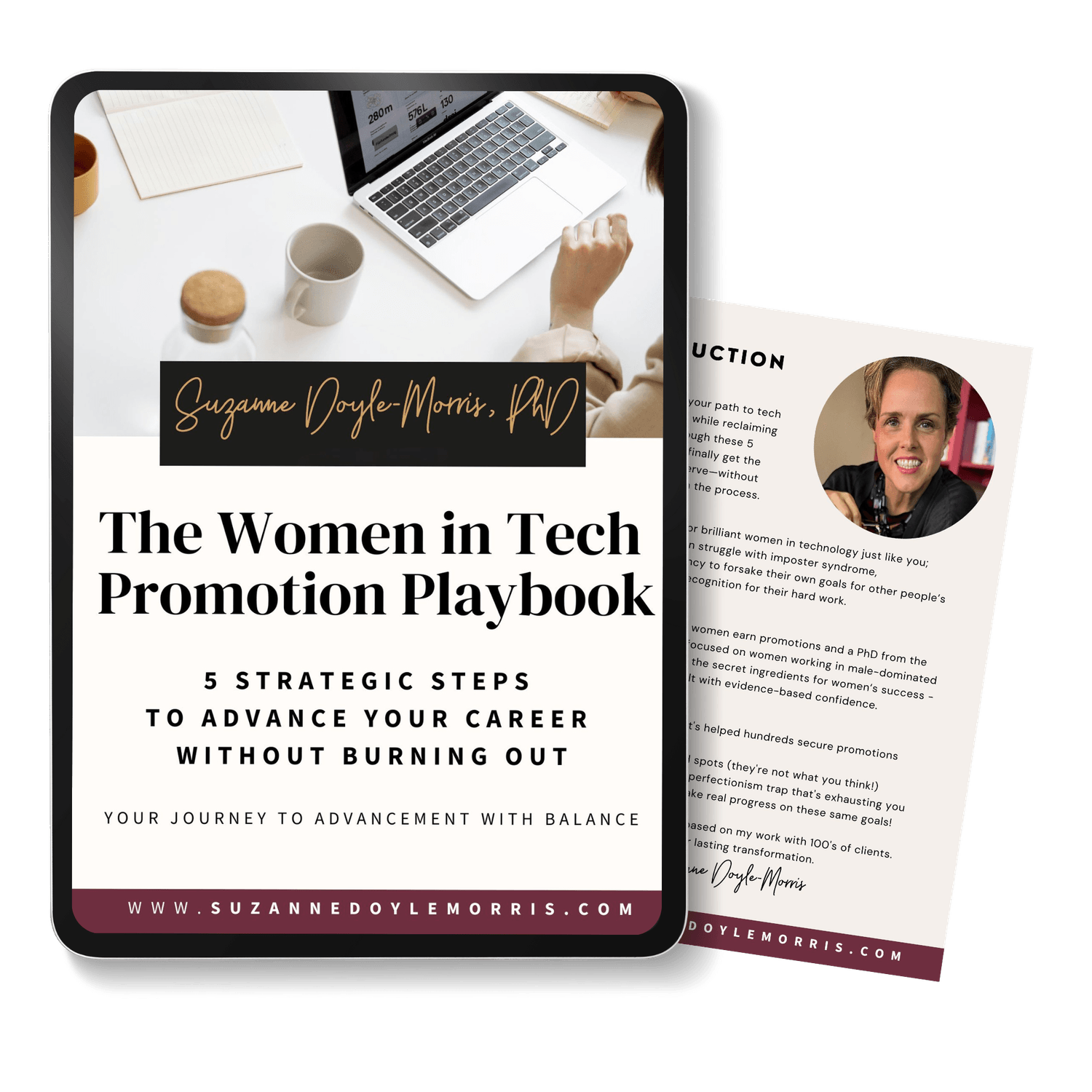
Your roadmap to advancement with balance.
The Women in Tech Promotion Playbook is a practical, evidence-based guide.
It's designed solely for ambitious women in STEM who want to advance their careers without burning out.
Drawing on over 25 years of coaching, research and consultancy, I outline five strategic steps that help women move from being overworked and under-recognised to confident, visible leaders.
Latest on the blog
The Women in Tech Promotion Playbook
Your roadmap to advancement with balance
The Women in Tech Promotion Playbook is a practical, evidence-based guide designed for ambitious women in STEM who want to advance their careers without burning out. Drawing on over 25 years of coaching and research, I outline five strategic steps that help women move from being overworked and under recognised to confident, visible leaders.


Free Workbook
The Senior Women in STEM Leadership Playbook
5 strategic steps to advance your STEM career — without burning out.
Ready to get recognised for the impact you already make? This free workbook gives ambitious women in technology a proven, evidence-based framework for earning promotions with confidence — while keeping balance and wellbeing intact.